

Researcher: Raquel Silvano Almeida, PhD. (Unespar/PR/Brazil); Supervisor: Telma Nunes Gimenez, PhD. (UEL/PR/Brazil)
Abstract
This paper is based on 2015 doctoral research exploring how English is commercially perceived in a globalized, neoliberal context. The main objective was to identify how eight teachers, participating in a continuing education course at a northern Paraná state university, represented the English language. The research corpus included audio transcriptions, blog posts, and open-ended questionnaire responses. Rooted in Social Representations Theory (Moscovici, 2003; Sá, 1998; Jodelet, 2001) and Content Analysis (Bardin, 1977), the study found that teachers’ representations either aligned with, diverged from, or intersected with the commercial view of English language teaching. The study advocates for critical-reflective development for English teachers, challenging the dominant notion that English is merely a tool or commodity in today’s global society.
Initial remarks on the Social Representation Theory (SRT)
My choice of the theoretical framework of social representations for this research stems from my understanding that the functions of representations, in accordance with the words of Alves-Mazzotti (2011, p. 30), are “to contribute to the construction of a reality shared by a social group and to guide and justify the practices of the individuals who comprise it.” Thus, I consider the theoretical contribution of Social Representation Theory (SRT) (MOSCOVICI, 2003; JODELET, 2001; SÁ, 1998) to be fundamental for studies in education and in AL (Applied Linguistics) in general, and, within the scope of this research on the development of English language teachers, as an essential tool for identifying the knowledge and social practices that are articulated within the relational space of the group of teachers under investigation.
Moscovici (2003, pp. 10 and 40) states, “[a]ll human interactions, whether between two individuals or two groups, presuppose social representations.” Based on this, I infer that social representations are present in almost tangible form. They are continuously crystallized in our social relations, in the communications we establish, and in the production of meanings we try to assign to the information we receive.
This framework, thus, caught my attention due to the feasibility of transforming a complex phenomenon—such as the commodification of English—into a research object and, in this process of transformation, seeing that it is possible to interpret it and make the representations expressed by the participating teachers visible and intelligible.
To address social representations in research, we must first recognize that they are not created in isolation or in a “social vacuum” (JODELET, 2001, p. 17). On the contrary, they take shape from the moment we communicate and share ideas and information in all the social contexts of our lives. For this reason, Jodelet (2001, p. 17) explains that representations are, in fact, social, as they help us adapt to the world around us and “guide us in how we collectively name and define the different aspects of daily reality, in how we interpret these aspects, make decisions, and […] position ourselves in relation to them […]”.
In general, scientific studies grounded in the Theory of Social Representations (TSR)—a framework that examines how shared beliefs, values, and practices shape individuals’ understanding of the world—seek to account for the manifestation of these social phenomena, meaning collectively constructed ideas or practices, and to understand how they are perceived, interpreted, visualized, and expressed in everyday life by individuals or social groups (SÁ, 1998; JODELET, 2001).
The organization and systematization of the “multidimensional” study of social representations, based on Moscovici’s theory, is presented by Jodelet (2001, pp. 27–28) as a synthesis of guiding principles that delineate the elements involved in the various research variables and issues addressed in these studies.
Thus, Jodelet (2001) outlines these key elements: a) “social representation is always a representation of something (an object) and someone (a subject); the characteristics of the subject and the object are manifested within it”; b) “social representation has a relationship of symbolization (substituting it) and interpretation (conferring meanings upon it) with its object”; c) “form of knowledge: the representation will be presented as a modeling of the object directly readable in (or inferred from) various linguistic, behavioral, or material supports”; d) “qualifying this practical knowledge refers to the experience from which it is produced, to the contexts and conditions in which it is produced, and, above all, to the fact that the representation serves to act upon the world and the other.” Subsequently, Jodelet (2001, p. 28) highlights three categories of issues: (1) “conditions of production and circulation of social representations”; (2) “processes and states of social representations”; (3) “epistemological status of social representations”.
The origins of the theoretical framework for the social phenomenon of representations lie in the ideas put forward by Moscovici (2003) for the development of a social psychology of knowledge. The social psychology of knowledge was a project developed in the 1960s and 1970s, in which he sought to understand the processes involved in the generation, transformation, and social projection of knowledge.
In developing this project, Moscovici (2003) understood that knowledge is processed, distributed, and represented by people in interactions and communication, and that this was already the subject of scientific study. However, as a social psychologist, he was concerned with understanding how and why people share knowledge and ideas and transform them into practice, thereby constituting a shared reality.
Therefore, Moscovici (2003) considered that the phenomenon of social representations was historically embedded in the different forms of communication that emerged in the modern era (the advent of the press and mass literacy), which generated new possibilities for the circulation of ideas. In this context, he sought to understand how representations are socially constructed, the different social processes that influence them, their power relations, and their dynamic nature.
In this sense, Moscovici (2003) posited that social representations are, in fact, a product of interaction and communication and take shape according to the specific characteristics of social influence processes. Consequently, it is possible to understand that there is a relationship between representation and communication. This is explained by Moscovici’s (2003, p. 21) definition of social representation as:
A system of values, ideas, and practices with a dual function: first, to establish an order that enables people to orient themselves in their material and social world and to control it; and, second, to make communication possible among members of a community by providing them with a code to name and classify, without ambiguity, the various aspects of their world and their individual and social history.
Content Analysis Method
In this study, the analysis of representations of English—as manifested through audio recordings, posts, and discursive responses from the eight participating teachers—was conducted using content analysis methodology, in order to identify and highlight the content of these representations, as well as to infer the underlying factors contributing to their formation, maintenance, or transformation.
Content analysis is known as a “set of methodological tools” (BARDIN, 1977; RICHARDSON, 2011) or “set of techniques” (GOMES, 1994) that applies to various types of discourse; it originated in the United States and is constantly being refined. According to Richardson (2011), the concepts attributed to “content analysis” have varied and been refined in accordance with its diversification in terms of “fields of application, in the formulation of new problems and new materials” (p. 222).
The concept proposed by Laurence Bardin (1977, p. 31) remains the most widely adopted to this day as, “[…] a set of communication analysis techniques aimed at obtaining, through systematic and objective procedures for describing the content of messages, indicators (quantitative or qualitative) that allow one to infer knowledge regarding the conditions of production/reception (inferred variables) of these messages.”
Analysis
Teachers’ representations of English were categorized into convergence and divergence images of the commercial nature of English, as follows:
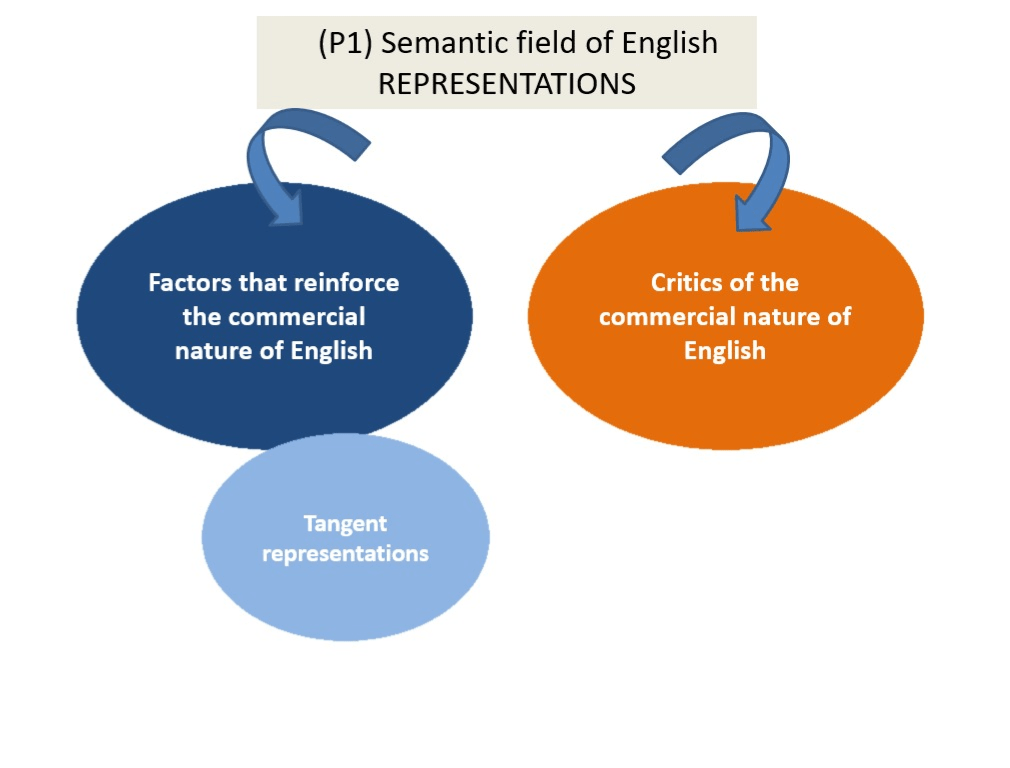
I – Convergence: factors that reinforce the commercial nature of English
Through the process of identifying these social representations—by analyzing their manifest content—it was possible to infer that these teachers essentially produced a range of meanings about English that underpin the economic, functional, and market-related characteristics of the language.
IMAGES: “money making,” “livelihood,” “work,” “possibilities,” “opportunities,” “expectations of a better life,” “earning a living,” “better financial life,” “universalization,” “totality,” “global communication and interaction,” “number one language,” “enables global communication via the internet,” and “ubiquitous as a consumer product.”
The market-oriented aspects of English in the four social representations expressed by the teachers are grounded in the perspective of the commodification of language (HELLER, 2005, 2010), reinforcing the exchange value of the product or commodity known as “English.”
From a triumphalist perspective (CRYSTAL, 1997; 2010), these representations are underpinned by a policy of expanding English as something natural, neutral, and beneficial, which links it to strictly functional and economic considerations regarding its teaching and learning in contemporary globalized society (PENNYCOOK, 1994; 2001), guided by a new neoliberal market economy (OLIVEIRA, 2006; SOUSA SANTOS, 2011), namely, a knowledge economy that requires the development of human capital in linguistic-communicative skills (OECD, 1996; HOLBOROW, 2012; CAMERON, 2002).
These meanings led me to assert that the four social representations reproduce the marketing discourses that circulate within the various discursive practices regarding the role of English today, in which the teachers participate. These representations, therefore, constitute a discourse of common sense in the professional and teaching daily lives of these teachers, which emphasizes the instrumentalization, utilitarianism, and commercialization of English teaching and learning, reproducing and reinforcing persuasive practices and ideologies sustained by media discourses—texts from the print, television, and online media in general —as well as advertising texts from language schools (CARMAGNANI, 2001; CORACINI, 2007).
These social representations occupy a predominant space in school teaching and learning. They take the form of a single or dominant mindset that the learning of English is intended to meet primarily utilitarian and functional needs for the student’s integration into the labor market, to allow them access to the consumption of products that culturally and socially identify them with the English language, and to their socioeconomic advancement in a neoliberal market-driven society.
II – Divergence: critics of the commercial nature of English
English is a “product,” an “imported product,” an “important brand,” something that is “consumed,” “everyone consumes this product,” “Brazilians (teachers) are consumers of this product”;
“overvaluation of English” and “it is us, the Brazilians, who attribute this value to the language.”
The teachers’ statements show that they reflected on the English language during the course from a critical perspective—taking a critical distance (PENNYCOOK, 1998; 2001) from economic and instrumental characterizations and meanings of English. These teachers’ critically engaged stances reveal their questioning of market-driven and utilitarian ideas about English—ideas that are generally accepted and are not typically questioned or challenged by teachers as they carry out their pedagogical work with this component of the school curriculum. These market-driven ideas were reinforced by most of the participating teachers during their involvement in the course.
Final remarks
All in all, the commodification of languages has emerged in the wake of recent global events, characteristic of neoliberal political, economic, and linguistic-cultural globalization.
I find it problematic that the multidimensional dynamics of current globalization are producing and defining a “common mindset or monologue” (MOSCOVICI, 2003). This mindset frames the teaching and learning of English in Brazil as intended strictly to meet labor-related and economic needs.
The representations that we teachers generally express about the English language are grounded in educational, media, political, economic, and marketing discourses, among others, which circulate within the various discursive practices that define the role of English today—practices in which we participate as both users and professionals of the language.
These representations of English reflect other discourses that shape the eight research informants as teachers and users of English and influence their teaching practices in public schools.
The continuing education course successfully shed light on and explored the participating teachers’ perceptions of English. The course’s critical-reflective approach highlighted certain efforts to deconstruct, denaturalize, and challenge the prevailing discourse on the commodification of English—core representations that raise critical questions. It facilitated the denaturalization of English’s promotional scope as a commodity.
There is a need for more comprehensive studies and discussions on this topic (Block, 2008; Jordão, 2009). These should involve professional development initiatives for current and future English teachers. The goal is to help them understand the potential political and pedagogical implications in their field within the context of globalization.
References:
ALMEIDA, R.S. Globalização do inglês: impactos mercadológicos e reflexos na formação de professores no Brasil. 1. ed. Campinas, SP: Pontes Editores, 2020. Disponível em: https://ponteseditores.com.br/loja3/pontes-editores-home-2__trashed/linguagem-e-linguas/produto-502/.
ALMEIDA, R.S. A MERCADORIZAÇÃO DO INGLÊS E SUAS REPRESENTAÇÕES POR PROFESSORAS EM FORMAÇÃO CONTINUADA. Tese de Doutorado. Universidade Estadual de Londrina. Programa de Pós-Graduação em Estudos da Linguagem. 2015. Disponível em: https://repositorio.uel.br/items/1854f9d3-084d-43d4-8be4-2f4b3f46b521.
NOTE: Teachers’ responses in Portuguese were translated into English in this paper.

