
Portuguese is one of the most widely spoken languages in the world. It originated in the Iberian Peninsula as a Vulgar Latin dialect and has developed over many centuries into a global language. Today, Portuguese is spoken by more than 260 million people worldwide, making it one of the most important languages for international communication.
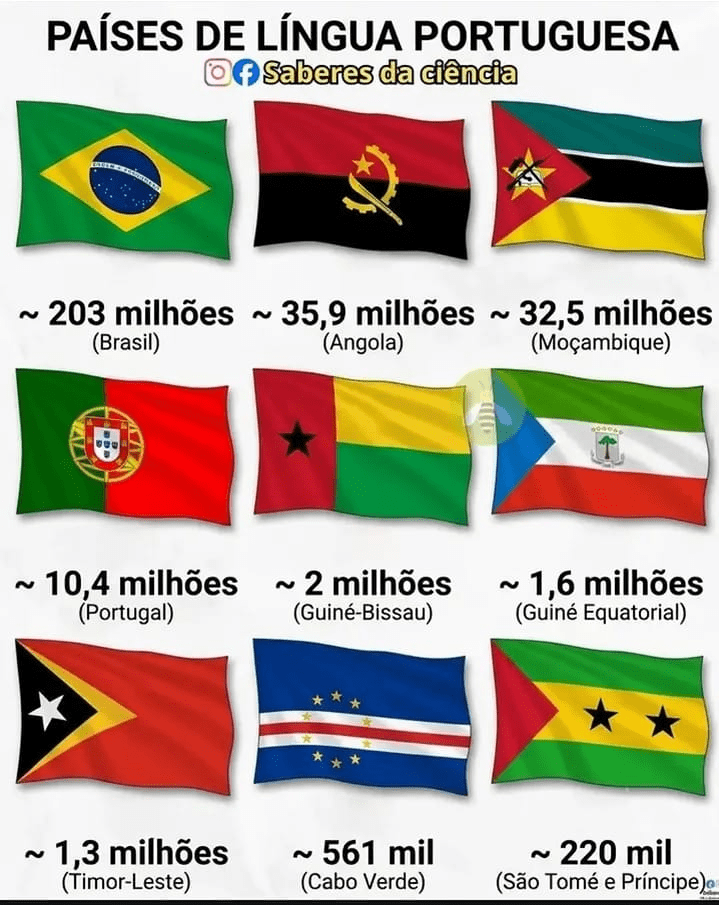
Portuguese is the official language of nine countries: Angola, Brazil, Cabo Verde, Guinea-Bissau, Mozambique, Portugal, São Tomé and Príncipe, Timor-Leste, and Equatorial Guinea. It is also spoken by millions of people in immigrant communities across Europe, North America, South America, Africa, and Asia.
According to computing scientist and Unicamp master’s student Nina da Hora from Instituto da Hora, Brazil (2026), although Portuguese is the fifth most spoken language in the world, with more than 260 million speakers, its presence on the Internet is still relatively limited compared with other global languages such as English, Spanish, and Chinese. Much of the online content, digital platforms, academic publications, and technological resources are produced in English, which reduces the visibility of Portuguese in the digital environment. Expanding high-quality content in Portuguese is essential to promoting linguistic diversity, increasing access to knowledge, and ensuring that Portuguese-speaking communities are better represented in the digital world.
In Brazil, Portuguese has been the official language since the Portuguese colonization, which began in the sixteenth century. Today, it is the language used in government, education, the media, and everyday communication throughout the country. Portuguese also plays a central role in the Brazilian educational system. According to the Base Nacional Comum Curricular (BNCC), that is, the National Common Curricular Base, Portuguese is a compulsory subject in basic education, aiming to develop students’ reading, writing, speaking, and listening skills, as well as their critical literacy and active participation in society:
The Portuguese Language component of the BNCC engages with curricular documents and guidelines produced in recent decades, seeking to update them in light of recent research in the field and the transformations in language practices that have occurred this century, due in large part to the development of digital information and communication technologies (DICT). This document adopts the enunciative-discursive perspective on language, as previously adopted in other documents, such as the National Curriculum Parameters (PCN), which define language as “a form of interindividual action oriented toward a specific purpose; a process of dialogue that takes place within the social practices existing in a society, at different moments in its history” (Brasil, 1998, p. 20)
The Portuguese-speaking world is rich in cultural diversity. Although the countries that speak Portuguese share the same language, each one has its own traditions, customs, music, food, literature, festivals, and ways of life. This cultural diversity makes Portuguese a truly global language and offers learners the opportunity to explore different histories, identities, and perspectives while communicating with people from various parts of the world.
The language has a rich cultural heritage, reflected in its literature, music, and traditions. As a global language, Portuguese continues to grow in importance in education, business, diplomacy, science, and tourism. Learning Portuguese provides access to diverse cultures and opportunities to communicate with people from different parts of the world.
In conclusion, Portuguese is much more than a means of communication; it is a global language that connects millions of people across different continents and cultures. As one of the world’s most widely spoken languages, it plays an essential role in education, international cooperation, business, science, and cultural exchange. Learning Portuguese provides access to a rich linguistic and cultural heritage while promoting intercultural understanding and global citizenship in an increasingly interconnected world.
References:
BRASIL, Ministério da Educação. Base Nacional Comum Curricular. Secretaria de Educação, DF: Brasília, 2018.
HORA, Nina da. Instituto da Hora. Centro de Pesquisa e Tecnologia com Incidência na Sociedade. Disponível em: https://www.institutodahora.com/. Acesso em: 15 julho 2026.

