
Authors: Danilo Azevedo de Arruda and José Vitor dos Santos Brandino
ABSTRACT:
This paper aims to discuss the recurrence of character trios across canonical literature and contemporary media and to explore how this narrative configuration can be used as a pedagogical bridge between young readers’ cultural repertoire and literary texts. Drawing on the concepts of intertextuality, multimodality, and adaptation, the study argues that contemporary media can provide meaningful points of connection with classical literature without replacing or simplifying it. Students can establish intertextual relationships and develop a more active and critical engagement with literary works by recognizing, comparing, and analyzing recurring character configurations.
KEY-WORDS: English; Literature; Ensino-Aprendizagem; Classics; Contemporary Media.
INTRODUCTION
According to Julia Kristeva (1980), “any text is constructed as a mosaic of quotations”; this means the world’s cultural production is made through transformation, not only invention. It’s not about creating something isolated; it is more about an absorption of content and reinvention. She called it “Intertextuality”: the way texts create relationships with one another and influence and reshape one another. In intertextuality, there is a word really present in the cultural world, and of course in the texts: Classic. “Based on traditions or established customs” is the definition according to the dictionary.
Recalling Latin, the word “literature” comes from “litera”, which means “an acquaintance with letters”, but throughout the ages, we have been defining literature from different perspectives. The literature concept addressed in this article is literature as aesthetic texts, which came from the final 18th century.
In this text, we build a brief analysis of how the classic literature, “the established customs”, remains active in contemporary works, recreating the stories and how important it is for the young generation to get in touch with its aspects.
METHODS AND PROCEDURES
Recalling Lakatos & Marconi (2003), research is “a systematic reflexive procedure, controlled and critical, that allows the discovery of new facts or data, relations […] with a reflective thinking method, which requires scientific treatment and constitutes the way to know reality or to discover partial truths”. Accordingly, this article will be based on a content analysis raising questions on how classic works and contemporary media can converge in order to approximate the young generation.
The qualitative approach is used to find representations of emblematic trios in literature and media.
Chacko Thomas says “researchers who subscribe to the qualitative paradigm view the social world as being of a much softer, personal and humanly created kind” (2002, p. X). The author also states that “another important aspect of qualitative research is that it is subjective, using language and description rather than numerals and figures” (apud Williams, 2008. p. 8).
This research applies deductive and inductive methods at once since we are raising themes and questions based on Literary studies in order to analyze the corpora and, at the same time, doing the opposite movement: researching possible themes in the corpora to be taken into analysis. According to Durão:
The concept of methodology can never act autonomously, but must always be subordinated to another, the criticism. When it comes to the methodology of literary studies as an inescapable precondition to criticize the desire to reify methodology as an end in itself. (Durão, 2015, p. 38)
Moreover, although the corpora mentioned in this article are a number of very well-known works, this research also uses the exploratory method, since we are going to use new paths for integrating these corpora together in classrooms.
LITERATURE, INTERTEXTUALITY AND YOUNG READERS
Literature can be understood not only as written language, but as a form of meaning-making shaped by readers and their cultural contexts. In the education of young learners, literary texts can be explored through different modes, including images, sounds, gestures, films, and other forms of representation. This multimodal perspective expands students’ possibilities of interpreting stories and encourages them to connect literary texts with experiences and narratives they already know.
In this sense, contemporary media can provide a valuable starting point for approaching literature. Young learners are constantly exposed to stories through films, series, animation, games, and digital platforms. These experiences are part of their cultural repertoire and can be used to establish connections with literary works.
Character trios, for instance, appear frequently across different narrative forms and can serve as a recognizable structure through which students compare contemporary characters with those found in classical literature.
If intertextuality proves that no text is born in isolation, few patterns illustrate this as clearly as the recurrence of the trio — a group of three characters who together carry a narrative forward. This structure appears across centuries, genres, and media, from canonical literature to contemporary pop culture, suggesting that what looks like a modern storytelling formula is, in fact, an echo of something much older.
Consider Shakespeare’s three witches in Macbeth, who speak of fate almost as a single prophetic voice. Their ancestry can be traced further back to the three MoiraI of Greek mythology — Clotho, Lachesis, and Atropos — who spin, measure, and cut the thread of life. The witches did not invent the archetype of the prophetic trio; they absorbed and reshaped it.
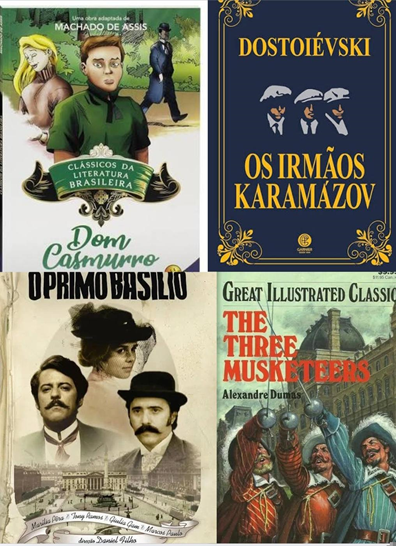
The same logic extends to Alexandre Dumas’s The Three Musketeers, where Athos, Porthos, and Aramis each embody a distinct trait — nobility, physical strength, and intellect — completed by D’Artagnan’s arrival.
Centuries later, the same functional division resurfaces in Harry Potter’s golden trio: Hermione as the intellect, Harry as the courage bound to destiny, and Ron as the loyalty and emotional anchor.

The Powerpuff Girls repeat the pattern in children’s animation — leadership, strength, and intelligence distributed across three distinct characters. The pattern continues in Percy Jackson (Percy, Annabeth, and Grover), in Stranger Things (Mike, Dustin, and Lucas), and in anime narratives such as the early team of Naruto or One Piece.
Character trios, however, are not only necessarily built around friendship, cooperation, or complementary abilities. In literature, three-character configurations can also organize narratives around conflicts, desire, betrayal, and ambiguity. In O Primo Basílio, by José de Alencar, the relationship involving Luísa, Basílio, and Jorge can be read as a triangular configuration in which marriage, desire, and infidelity generate the central conflict of the narrative. Similarly, in Machado de Assis’s Dom Casmurro, Bentinho, Capitu, and Escobar form one of Brazilian literature’s most controversial character configurations. The relationship among the three characters is marked by suspicion, jealousy, and uncertainty, particularly because the narrative never definitively establishes whether Capitu and Escobar were involved romantically.
These examples expand the concept of the character trio beyond the idea of three protagonists working together. A trio may also emerge from a relational structure in which the presence of one character affects the relationship between the other two. In this sense, the pedagogical exploration of trios can lead students not only to identify recurring narrative patterns, but also to examine how different authors transform these patterns to construct conflict, perspective, and ambiguity. Such examples are particularly valuable because they demonstrate that recognizing a familiar structure does not provide a definitive interpretation of a literary work; instead, it can serve as a starting point for questioning how and why that structure operates within each narrative.
Despite the trios — three characters — in literary stories throughout human history, the number three as a pattern is based on logical criteria. “Trebling” appears in old fairy tales as the trebling of characters, tasks, attempts, or outflows. It provides pacing in the narrative, preventing a quick solution to the events and predictability, especially in folk tales.
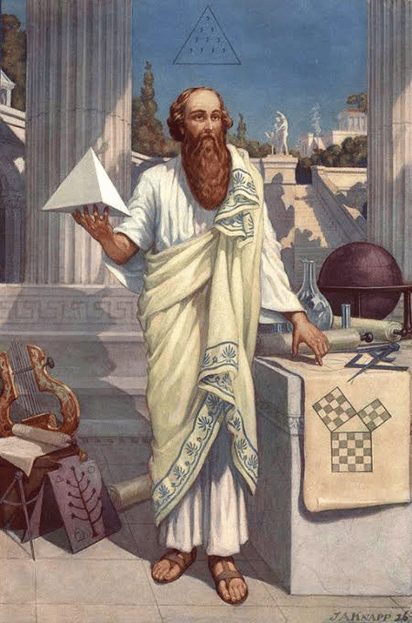
The numbers were considered sacred by Pythagoras and his school of thought, and they were also his arché — the beginning or origin of the world — especially the number “3”, which represented the fundamentals of wisdom, understanding, and perfection. The great spectacles are composed in three: past, present, and future; Beginning, middle, and end; Birth, life, and death.
Using mathematics as an approach to analyze the number three, we could conclude some unique aspects: This number is the very first odd prime number; A whole number is perfectly divisible by 3 if the sum of its individual digits is also a multiple of 3; The first number to form a closed shape — The triangle — which is by itself another deeper study.
The rule of three was intentionally used in crucial moments of history:
● Liberté, égalité, fraternité – Slogan of the French Republic
● Veni, Vidi, Vici – Quote often attributed to Julius Caesar
● Life, liberty, and the pursuit of Happiness Rights in the U.S. Declaration of Independence
Even in a spiritual context, we are able to see the trebling, such as in the Christian faith: Father, Son, and Holy Spirit. In Greek mythology, we have Zeus, Hades, and Poseidon. In Hinduism, there are Vishnu, Brahma, and Shiva.
FROM CANON TO POP CULTURE: A BRIDGE FOR YOUNG LEARNERS
The trio pattern offers more than an analytical curiosity — it offers a pedagogical opportunity. Young readers already recognize this structure intuitively through the media they consume: games, series, animations, and franchises they engage with daily.
Rather than treating classic literature as distant or difficult, educators can use the trio as a bridge. They can show students that the structure they already love in Harry Potter is the very same structure operating in Shakespeare or Dumas.
Given this perspective, this paper also aims to provide some pedagogical suggestions for English language classrooms by exploring character trios as recurring narrative structures across classical literature and contemporary media. The proposed approach draws on the recognition of familiar character configurations in films, series, animation, and other forms of popular culture, relating them to trios found in literary works.
Rather than replacing literary reading with contemporary media, the intention is to use students’ existing cultural repertoire as a starting point for establishing connections, identifying similarities and differences, and encouraging closer engagement with literary texts. In this sense, the recognition of familiar narrative patterns can serve as a bridge toward literary reading, fostering reflection, intertextuality, and a more active relationship between young readers and literature. This progression reframes classic literature not as a separate, intimidating tradition but as the origin point of stories students already recognize and enjoy nowadays. This suggests some pedagogical approaches to this theme:
1. Recognition — present a popular media trio (e.g., the Golden Trio of Harry Potter) and ask students to describe each character’s narrative function, without yet referencing any classic work.
2. Mirroring — introduce a classic trio (the three musketeers, or Shakespeare’s witches) and ask students to draw parallels with the previously discussed popular trio.
3. Revealing intertextuality — the use of a theoretical basis shows that this pattern is not a coincidence but a structure recurring across centuries, returning to the article’s own premise: there is nothing new under the sun.
4. Production — invite students to create their own fictional trio applying the trifunctional logic, then connect that exercise to a reading of an excerpt from a classic work.
CONCLUSION
The persistence of the trio — from the Moirai to the witches of Macbeth, from the three musketeers to the golden trio of Hogwarts — demonstrates the concepts discussed in this text in its clearest form: no text is created in isolation, but rather as a reweaving of structures, archetypes, and patterns that precede it. Classic literature, far from being a closed and distant tradition, continues to live inside contemporary media, disguised in narratives young people already know and love.
By making this continuity visible — moving from recognition of a familiar pop-culture trio to the mirroring of its classic counterpart — educators can transform the encounter with classic literature from an imposition into a revelation. The young generation is not distant from classic literature; they have already been engaging with its structures all along, without knowing it. Indeed, there is nothing new under the sun.
REFERENCES
AULETE. Clássico. Dicionário Caldas Aulete. Disponível em https://www.aulete.com.br/cl%C3%A1ssico Acesso em: 12 set. 2026.
BRASIL. Ministério da Educação. Base comum curricular. Brasília: MEC, 2017. Disponível em: <http://basenacionalcomum.mec.gov.br/images/BNCC_EI_EF_110518_versaofinal_site.pdf >. Acesso em 13 set. 2026
KRISTEVA, Julia. Word, Dialogue and Novel. In: KRISTEVA, Julia. Desire in Language: a semiotic approach to literature and art. New York: Columbia University Press, 1980. p. 64-91.
LEITE, Carlos Augusto Bonifácio. UNIVESP. Teoria da Literatura – O que é a literatura? YouTube, 3 out. 2024. Disponível em: https://www.youtube.com/watch?v=ElSDjDYYgac. Acesso em:13 set. 2026.
MARCONI, M. A.; LAKATOS, E. M. Fundamentos de metodologia científica. 5ª ed., São Paulo: Atlas,2003.
MOTTA-ROTH, D.; HENDGES, G. R. Produção textual na universidade. São Paulo: Parábola, 2010.
PROPP, Vladimir. Morphology of the folktale, 1 jan. 1928
TONELI, j. KIELING,h. A LITERATURA NAS AULAS DE INGLÊS COM CRIANÇAS DA EDUCAÇÃO INFANTIL DA REDE PÚBLICA: UMA POSSIBILIDADE DE INTEGRAÇÃO AFETIVA ENTRE FAMÍLIAS E SALA DE AULA.Pedro & João Editores http://www.pedroejoaoeditores.com.br 13568-878 – São Carlos – SP 2025
THEUGLYWRITERS. Definition of Literature. World Literature, 13 nov. 2013. Disponível em:
https://nuworldlit.wordpress.com/2013/11/13/definition. Acesso em: 13 set. 2026.
WELSH NATIONAL OPERA. Three is the magic number. WNO News, Cardiff, 26 mar. 2019. Disponível em: https://wno.org.uk/news/three-is-the-magic-number/Acesso em: 14 set. 2026.
Danilo Azevedo de Arruda is an English language teacher and writer of horror short stories. In his literary work, he explores narratives marked by suspense, fear, and the supernatural. He also has an interest in philosophy and marketing, fields that contribute to his educational development and his professional and creative work.

José Vitor dos Santos Brandino holds a university degree in English Language and Literature from the State University of Paraná and a graduate degree in Linguistics and Applied Linguistics for Language Teaching. He teaches in the public school system of the state of Paraná and also works as a tutor in Japanese language instruction. Throughout his academic and professional career, he has conducted research and produced work focused on English language teaching using media, decolonial perspectives, language teaching and learning processes, and the training of English language teachers. He also works as a content creator in the field of languages, with a total of 6 million views. He has experience as a translator, having worked for nearly a decade in various contexts involving the Japanese language.
 Revista Contemporartes