
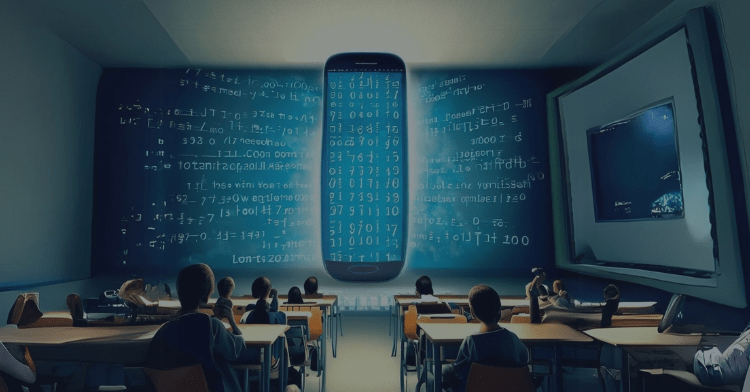
In this brief debate, we examine whether teachers’ autonomy is being eroded. We focus on the pedagogical mediation of the teaching and learning process. This concern stems from the mandatory implementation of virtual platforms in English-language classrooms. These platforms are a consequence of the educational policies set forth by local authorities in Brazil.
The integration of Digital Information and Communication Technologies (DICT) into the school curriculum should involve discussions. According to Brito (2006), reflections are also necessary. These can enhance the impacts that these technologies bring to the teaching and learning process. They can also improve the curriculum overall.
Portuguese researcher António Nóvoa (2023) said in an interview that “school serves to educate humans by humans.” This education is for the good of humanity. He emphasized that “education is always a human relationship. Machines don’t educate.” So, “it is not possible to educate ourselves alone, in front of a machine.” We need others, like teachers and classmates, to educate us. Digital tools can help cooperation in mutual work at school. According to Nóvoa (2023), “[t]he understanding of the need for technology in education is pertinent. Yet, our problems are still pedagogically related to its use” in the teaching and learning process.
Finardi and Porcino (2014) recognize that technologies have expanded our means of expression in teaching and learning. They have also contributed to the development of foreign language teachers. This expansion has transformed how we convey ideas. The Internet, in particular, plays a significant role in this expansion. They have changed how we interact in and with the world. This also applies to the target language. They have moved from a peripheral role of simple pedagogical support to a central role in language teaching and learning. As Paiva (1999, p. 375-376) has already pointed out, “technology will not replace teachers, but teachers who use technology will probably replace those who don’t”.

Teachers’ autonomy faces threats. These arise from the mandatory use of virtual platforms in the didactic-pedagogical process at schools. Spanish researcher José Contreras (2002) refers to this as the phenomenon of the “proletarianization of teachers”. After the worldwide implementation of the process of rationalizing work, the workers’ actions became prone to prior planning by others. This occurred in the Taylorist and Fordist modes of capitalist production from 1911 onwards. As a result, the educational system also suffers from the impact of these transformations in the world of work.
According to Contreras (2002), teachers lose their autonomy at work. They lose control and meaning over their own teaching work through technical work. This involves a separation between conception and execution of the action. The educational curriculum becomes a production process. Technologies control or guide the teaching and learning process.
Thus, teachers must understand how the social relations of work intervene in this teaching and learning context. These relations take away the role of teachers to consume prescribed platformized curricula. This is especially important in their actions as English language teachers. The commitment is to train students with “executive minds” (the professional for the job market). Alternatively, students can be trained with “thinking minds.” These individuals have tools that allow them to criticize what is set in society and act on it.

References:
BRITO, S. G. Tecnologias para transformar a educação. SANCHO, J. M.; HERNANDEZ, F. et al. (Org). Porto Alegre: Artmed, 2006. RESENHA. Educar, Curitiba, n. 28, p. 279-282, 2006. Editora UFPR, p. 279-282.
CONTRERAS, J. A autonomia de professores. SP: Editora Cortez, 2002.
FINARDI, K. R.; PORCINO, M.C. Tecnologia e Metodologia no Ensino de Inglês: impactos da globalização e da internacionalização. Ilha do Desterro, Florianópolis, v. 66, 2014, p. 239-284.
NÓVOA, A. Entrevista concedida à Fundação Telefônica Vivo no dia 21 de janeiro e 2023. Disponível em: https://www.fundacaotelefonicavivo.org.br/noticias/para-antonio-novoa-o-digital-e-um-meio-poderoso-para-reforcar-a-democracia-na-educacao/. Acesso em: 03 maio 2025.
PAIVA, V. L. Diários online na aprendizagem de língua inglesa mediada por computador. In: MARI, H. et al. (Org.) Fundamentos e dimensões da análise do discurso. Carol Borges: Belo Horizonte, 1999. p. 359-378.
 Revista Contemporartes