

Throughout the long history of language teaching in the world and in Brazil, the most commonly used methods belong to the grammatical approach. This means that grammar is often central to the organisation of teaching and learning. Teaching is organised around grammar and units are adapted to counteract the stressful effects of work on the form of the target language.
According to Almeida Filho (2010), the most commonly used methods in Brazilian schools are structural grammar-audiolingual and grammar. Structural grammar-audiolingual includes dialogues, explanations of structures and vocabulary items, and lots of practice with the structure patterns of the new language being learnt. The second method is structural, attenuated audiolingual with mechanical repetition.
Language is not just a set of grammatical rules to be memorised and used to ‘communicate’, though. We often see a pedagogical approach that focuses on memorising structures in the context of teaching English as a foreign language. In many schools, grammar is taught in isolation, without reference to possible contexts of use (Fenner; Corbari, 2004).
According to Larsen-Freeman (1999) grammar is to be seen as a skill not as a competence. That is, when we speak or write, we are always involved in “doing” grammar, whether consciously or unconsciously. Hence, this process of doing grammar is termed “grammaring”.
Larsen-Freeman (1999) proposes “grammaring” as an important process in second language acquisition. Grammaring emphasizes grammar as a dynamic process rather than a system of rules. She points out “grammaring” can be seen as a “fifth skill.” Her definition of the word is as follows: “the ability to use grammar structures accurately, meaningfully, and appropriately”.
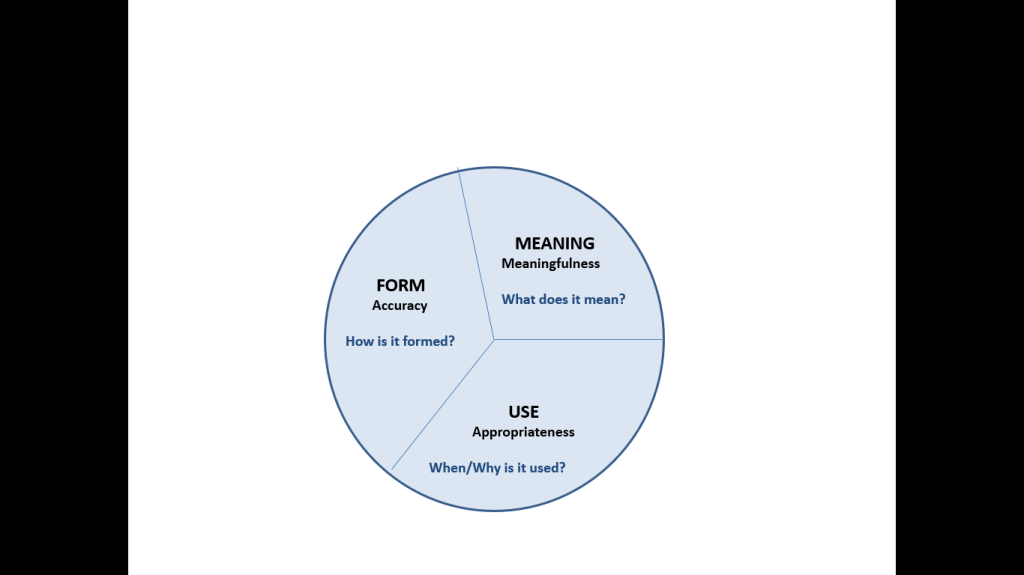
Based on that pie chart, in language teaching, Oliveira (2015) takes into account as follows:
Formal dimension: grammatical and structural accuracy. How does the grammatical element have this structure?
Semantic dimension: the meaning of the grammatical element. What does it mean?
Pragmatic dimension: the appropriateness of the grammatical element to the context. When and for what purpose is this grammatical element used?
Likewise, Nunan (2005) states that in genuine communication beyond the classroom, grammar and context are often closely related. Appropriate grammatical choices can only be made with reference to the context and purpose of the communication.
As teachers, we need to help learners see that effective communication involves achieving harmony between functional interpretation and formal appropriacy by giving them tasks that dramatize (show/reveal) the relationship between grammatical items and the discoursal contexts in which they occur (Nunan, 2005, page 192).
Moreover, he points out that only a handful of grammatical rules are free from discoursal constraints. This, by the way, is one of the reasons why it is often difficult to answer learners’ questions about grammatical appropriacy: in many instances, the answer is that it depends on the attitude or orientation that the speaker wants to take towards the events he or she wishes to report.
He proposes an organic approach to second language pedagogy, as follows:
Building a wall (linear model): Grammar is taught as isolated bricks. They are presented one at a time. This approach is linear and out of context.

Growing a garden (organic model): There is the interaction of language elements (simultaneity), the relationship between form-meaning-use, and context.

In short, language teachers need to supplement form-focused exercises with an approach that dramatizes the fact for learners that different forms allow them to express different meanings. Grammar enables them to make increasingly sophisticated meanings. It allows them to escape from the tyranny of the here and now. Learners can not only report events and states of affairs, but they can also editorialize. This means they can make comments or express opinions rather than just report something. Additionally, they can communicate their own attitudes towards these events and affairs.
References:
ALMEIDA FILHO, J.C.P. Dimensões comunicativas no ensino de línguas. Campinas, SP: Pontes,
3 ed., 2010.
FENNER, A. L.; CORBARI, C.C. Reflexões sobre o ensino de língua estrangeira em terras brasileiras. Reducere et Educare Revista de Educação. Vol. 1. Número 1. jan/jun, 2006, p. 197-202.
LARSEN-FREEMAN, D. Techniques and principles in language teaching. Oxford: OUP, 1999.
NUNAN, D. Teaching Grammar in Context. ELT Journal. Volume 52/2 April. Oxford University
Press: 2005.
OLIVEIRA, L. A. Aula de inglês: do planejamento à avaliação. 1. Ed. São Paulo: Parábola,
Editorial, 2015.
 Revista Contemporartes