

The historical relations between the English language and globalization serve as a backdrop to understanding the different phases of this language known today as “global”. Both globalization and the spread of English have a long trajectory of time and space and, therefore, cannot be seen as “totally” recent phenomena but with dominant characteristics marked by influences and remnants of their previous periods.
Taking into account the phases of development of societies and the current moment of globalization, we analyze that English has gone through distinctive stages of expansion articulated to the historical processes of the civilizing mission, territorial development, industrialization, modernization, and contemporary globalization.
We identify these processes, chronologically and spatially, from the European ideology of civilization, through the Westernization of the world, to its current stage of transnationalization and globalization of markets.
In its first expansionist stage, English served as an instrument of evangelization and English colonization in Europe in a process considered as “forced modernization” of the dominant populations. Within these purposes, the English language was, to some extent, taught to the native people of the British colonies and used in the activities of administrative control and trade in these conquered territories. As Pennycook (2001, p. 59) maps, this expansionist colonial policy translates the role of English as a language as inherently “useful and taught as a means of civilizing the world.”
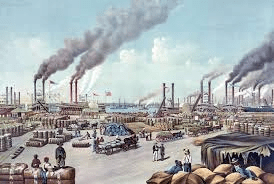
The development stage continued with the Industrial Revolution, marking the ground for English expansion’s second phase. It went from being a missionary and civilizing language to becoming one that served to drive, mediate and propagate industrialization in Europe. At the height of the first Industrial Revolution in England, considered the cradle of the ideas and principles of capitalist society, this event marks the establishment of the machine-made production process and the ideology of individual interests in material progress and the accumulation of capital (profit).
In the third phase, the expansion of English is marked by modernist ideological assumptions that consider this language an instrument of modernization. It is a period that occurred after the Second World War, in which the world was divided into two large blocks (Cold War): the Soviet Union and the United States. The United States, as the winner of this war, established a model of modernization of the world under different economic and political constraints. In addition, three international financial institutions were created, namely the International Monetary Fund, the World Bank, and the World Trade Organization, which were (and still are) active institutions in constructing a global economy based on the North American economic market rules.

The fourth and current stage of globalization, as well as the expansion of English, are marked by a “world system in transition” that undergoes significant changes as a result of new international divisions established by a new “pro-market” political economy, a neoliberal market, in which “the institutions governed by the State are corporatized” until then (SOUSA SANTOS, 2011, p. 15). It is the economic globalization of mercantile capitalism, still driven by the United States and which presents a set of characteristics that, according to Sousa Santos (2011, p. 76), are present at global levels: “the prevalence of the market principle over the State principle, the financialization of the world economy, the total subordination of labor interests to the interests of capital and the unconditional protagonism of multinational companies.”
REFERENCES:
ALMEIDA, R. S. Globalização do inglês: impactos mercadológicos e reflexos na formação de professores no Brasil. Campinas, SP: Pontes Editores, 2020.
PENNYCOOK, A. Critical applied linguistics: a critical introduction. London: Routledge, 2001.
SOUZA SANTOS, B. A globalização e as ciências sociais. 4 ed. São Paulo: Cortez, 2011.
Images:
It is available at https://www.canstockphoto.com/images-photos/globalization.html
It is available at https://malevus.com/industrial-revolution/
It is available at https://patimes.org/public-administration-era-globalization/
 Revista Contemporartes