
By Hugo Augusto Costa*
Teaching children might always be a challenging practice. May they be wrong when they say it requires no preparation, just basic knowledge on caring for the small ones. In the book “Teaching Languages to Young Learners” (CAMERON, 2001), we prove that it is indeed essential that teachers study the necessities of this phase of development before even stepping into a classroom. We say it because a whole piece of literature has been written only to prepare teachers to do so.
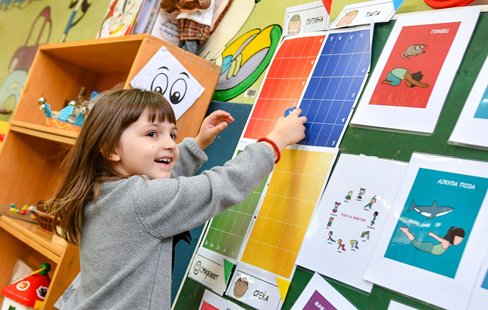
The second chapter, “Learning language through tasks and activities,” shows that kids naturally look for meaning and purpose when doing anything. This way, teachers could use this characteristic to motivate young learners. However, remember that if students do not understand what is supposed to be done, they will probably act as if they had gotten it because they want to please the teacher. Tasks, when well explained and assigned, could indeed be a resource for learning.
Image 1: Student progressing in a purposeful activity.
Task demand is another topic to be aware of. In the text, the author analyzes a piece of activity brought from a didactic material book. With it, it was too much attention to different tasks to do what was supposed to be a simple and easy activity. When assigning kids activities, it should be in our minds and worth considering: one step at a time. Connected to it, the teacher may offer task support or a mediator who could also be a peer. Modeling will be helpful to help students understand the task proposed.
The teacher’s help is required, but they do it consciously. The task should be demanding but not too demanding; support is needed, but not too much support. Balance it. In this gap, students learn and develop their skills and advance. In the text, it is compared to going to the gym and lifting weights: you should try one that is slightly heavier so that it will naturally become your new limit. When setting goals for learning, the teacher is responsible for planning not only the teaching but also the learning. What are students supposed to develop with the activity I am proposing? Ask yourself before planning your moves.
Image 2: Teacher’s intervention when necessary.

Thus, it is essential to define what the task is. Otherwise, as it is said in “O Pequeno Príncipe” (SAINT-EXUPÉRY, A. de, 1943), any path would be suitable if you do not know where to go, and this is not the case. We want to prepare our students for specific uses of the additional language, so we must know where we want to get. Moreover, the task stages are also of extreme importance. It may be structured in preparation, core activity, and follow-up. Finally, we cannot forget that, even when planned, some things may take another path rather than the one designed by the teacher. However, the teacher still has a plan and a goal to reach. This way, it will be possible to return to the road.
Image 3:The teacher is listening and mediating his students through their learning process.

References:
CAMERON, L. Teaching Languages to Young Learners. UK: Cambridge University Press, 2001.
SAINT-EXUPÉRY, A. de. O Pequeno Príncipe. Tradução Dom Marcos Barbosa. – 1. Ed. – Rio de Janeiro: Harper Collins, 2018.
Images:
Image #1 is available at https://www.unicef.org/northmacedonia/play-based-learning-activities-children-aged-3-10
Image #2 is available at https://www.edutopia.org/article/how-talk-children/
Image #3 is available at https://www.gettingsmart.com/2018/01/14/the-secrets-to-great-teaching/

 Revista Contemporartes