Author: Hugo Augusto Costa*
Abstract
Considering my own experience as an English language student in the Língua Estrangeira Moderna discipline in public school, I found a lack of practice considering the oral exposition. Now, while studying to be a foreign language teacher myself, I have been in contact with different approaches and methodologies, which objectives are to provide students with a meaningful experience and develop their different abilities in a variety of ways. Back then in my school years, “Base Nacional Comum Curricular” (BNCC) had only been implemented for a few years. This document, from 2017, guides the teaching in the whole country of Brazil, and, consequently, the learning. The aim of this paper is to analyze oral-practice activities in the teaching of English as a foreign language in remote classes (Google Meet) in a public-school context, in relation to the prescriptions of the BNCC document and students’ participation. As specific objectives, we established: to identify oral-practice activities in the teaching of English as a foreign language in remote classes in a public-school context; to establish the (in)coherence between the oral practice observed and the ones recommend by BNCC; and to understand how students participate in the oral-practice activities observed.It was decided that the best method to adopt for this investigation was one of a qualitative nature. Thus, an interpretive content analysis of data content was led. Data were gathered and registered in a reflexive diary while the author observed a remote English class on a Web platform. The diary reveals the activities developed during the class, which are analyzed concerning what the BNCC document establishes for the development of oral skills in the 7th grade in the English language. As analysis criteria to answer the research question of analyzing speakers’ oral participation during the class observed, a deductive method was used to interpret their engagement according to Fogaça (2010), Lenharo and Cristovão (2016).We observed that oral-skill activities were presented in the observed English class in the public-school context researched with certain limitations. These speaking activities seem to briefly help developing the competencies established by the BNCC document. Finally, when we consider students’ engagement to the speaking activities proposed, we found that students were less likely to answer questions spontaneously, both in English and in Portuguese; they would produce using the foreign language mostly when asked by the teacher – and it happens not only spoken, but also written.
Key words: Base Nacional Comum Curricular. BNCC. Oral skills. Public school.
1. Introduction
Considering my own experience as an English language student in the Língua Estrangeira Moderna discipline in public school, I found a lack of practice considering the oral exposition. Now, while studying to be a foreign language teacher myself, I have been in contact with different approaches and methodologies, which objectives are to provide students with a meaningful experience and develop the different abilities in a variety of ways. The communicative approach, the genre-based approaches, the development of critical thinking, and working with interdisciplinarity, are some examples of ways of teaching that fascinate me as a student-teacher and can be used in order to develop speaking considerably.
Back then in my school years, “Base Nacional Comum Curricular” (BNCC) had only been implemented for a few years. This document, from 2017, guides the teaching in the whole country of Brazil, and, consequently, the learning. Not only glad I was when studying the document and finding advances and attention to the oral skill, but also thoughtful if the document’s implementation has been bringing results and changes to the reality I used to face as a student.
Having this in mind, the aim of this paper is to analyze oral-practice activities in the teaching of English as a foreign language in remote classes (Google Meet) in a public-school context, in relation to the prescriptions of the BNCC document and students’ participation. The analyzes will be guided by the following research questions: in what extent are oral-skill activities present in the observed English class in this public-school context researched? What are the similarities and/or differences between what is recommended by the BNCC document and the oral-activities developed during the observed class? When brought to class, how do students engage to the speaking activities proposed? By bringing the observing classes in the internship, real classes will be analyzed in meaning to understand which goals expressed on BNCC are being achieved or not.
It is important to mention, still in the introduction section, that the remote classes via Google Meet happened as a consequence of the pandemic moment, which haunted us all during the last two years (2020 and 2021). Because of that, classes at school were being attended online as a way to keep the social distancing. In the state of Paraná, where the school is located, schools kept their students active. One way for doing that were the video calls with teachers and their students.
For this purpose, this paper has been divided into four parts. The first part begins by laying out the theoretical dimensions of the research, and looks at school documents that establish competences to be developed during the years of study. The reader finds some excerpts and reflections on the teaching and learning that are guided by school documents. In the second part, methodology is found describing and justifying our choices for this research paper. The third part brings the results found and discusses about them thoroughly. Finally, the fourth part deals with the conclusion of our study and gives a brief summary and critique of the findings.
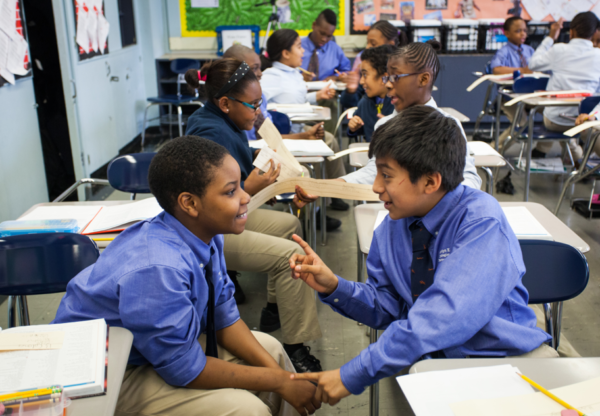
Image 1: Students talking, practicing oral skills
Source: https://teachlikeachampion.org/wp-content/uploads/TT-2-Image-600×416.png
2. Theoretical framework
2.1 The teaching and learning process and their relation to school documents
The teaching and learning at schools are guided by school documents that prescribe the contents that will be worked throughout the years of study. The first section of this paper will examine the document Base Nacional Comum Curricular (BNCC), which is one of these documents that are developed to guide teachers in their practice and, consequently, students in their studies. The starting point for BNCC’s production is overcoming the flunking and school leaving among high-schoolers especially. BNCC was thought and produced with the collaborative work and discussions of the society, specialists in different areas of study, and Brazilian teachers and educators.
There is currently a great debate on the Base Nacional Comum Curricular’s implementation, not only in terms of the theory brought by it, but also the current outcomes got by teachers and students. For its implementation, Branco (2017), stated that it was possible to anticipate that educational professionals would need to be trained and enabled for that matter.
Our aim with this research paper is not to take a position in favor or in opposition to the BNCC document, but to analyze the way that the oral skill is portrayed in the document and, also, the guidelines to the teacher’s work
2.1.1 Base Nacional Comum Curricular’s competences
Previously to its development, other school documents conducted the process of teaching in meaning to establish valid educational standards; as the document “Lei de Diretrizes e Bases da Educação (LDB) to exemplify. The BNCC document does not come to repress the previous ones, but to bring a new approach to teaching and learning. It lines up not only the contents but also the competencies students are meant to develop in each step during their study life. Commenting on this, it is said:
When saying the curricular contents are of service of competencies development, the LDB document guides the definition of essential learning, and not only of the minimum contents to be taught (BRASIL, 2017, p. 11, translated). [1]
There are ten of these competencies. When it comes to language teaching and learning, one of the competencies is related to this process when students develop the usage of different kinds of speech, being “verbal […], corporal, visual, sonorous and digital […] to express oneself and share pieces of information, experiences, ideas and feelings in different contexts” (BRASIL, BNCC, p. 9, translated). [2]
Considering the foreign language teaching in this brand-new document, the English language receives a new definition compared to its previous mentions on other school documents. On BNCC, the conception of the English language is the one of lingua franca. As defined on the Base Nacional Comum Curricular document on page 242, the English language is not considered as one from foreigners only, but a language that is spoken across the world and may be used with different linguistic and cultural repertoires. “To situate the English language in its status of lingua franca implies the comprehension that certain beliefs – as the one there is a “better English” to be taught […] needs to be relativized” (BRASIL, BNCC, p. 242, translated). [3]
The English taught will work with different focuses to develop the language as a whole, practicing the multiple abilities in it; such as oral practice, reading, writing, linguistic knowledge, and intercultural dimension. All of these focuses are related to the social practices in which the language would be used: “it’s the language in usage, being always hybrid, polyphonic and multimodal” (BRASIL, BNCC, p. 245, translated) [4]. As presented later on, still on page 245, these focuses on the language, like writing, for example, should not be the starting point to the language use. But it is from the usage of the language – as a dialogue, for instance – that the teacher will present the linguistic knowledge, like grammar and vocabulary.
2.1.1.1 Oral skill contents established for the teaching of English to 7th grade
As mentioned before, the Base Nacional Comum Curricular works with multiple competencies to be developed during the school years. When it comes to the specific competencies to the English language discipline, there are six of them which are meant to be advanced throughout the middle school years. Some of these are: to communicate in the English language; to identify similarities and differences between the English language and the student’s mother tongue or other languages; to elaborate linguistic-discursive repertoires of the English language and recognize the linguistic diversity as a right and to value the heterogeneous usages of it (BRASIL, BNCC, p. 246, translated). These competencies will guide the teacher’s planning to explore the contents which will be used in their classes.
Image 2: Planning lessons

Source: https://englishclassviaskype.com/wp-content/uploads/2019/03/planning-English-classes-300×263.jpg
In each grade at school students are expected to be exposed to certain practices which are essential to the phase they are in; then, in the following year, new studies will be developed considering previous knowledge. For 7th grade, to exemplify, in the reading axis, students are exposed to reading practices of several texts in English: verbal, verb-visual, and multimodal (BRASIL, BNCC, p. 252, translated). When it comes to the writing axis, practices of writing in English related to students’ daily life. (BRASIL, BNCC, p. 254, translated). For the linguistic knowledge axis, lexicon and grammar studies are conducted, looking for practicing the linguistic analysis to reflect on the functioning of the English language (BRASIL, BNCC, p. 254, translated). Finally, in the intercultural dimension axis, reflections about aspects related to culture interaction – as students’ and the ones from speakers of English, are defined (BRASIL, BNCC, p. 254, translated).
When it comes to the oral axis, which is the focus of the paper, for the 7th grade, the BNCC document recommends the development of “practices of oral comprehension and production of the English language, in different face-to-face or simulated discursive contexts, with a repertoire of different speeches, including the speech of the teacher” (BRASIL, BNCC, p. 252, translated). [5]
On BNCC, there are specific abilities that may be worked in other years of study as well, as it may be meaningful to students. But to analyze the oral practice in this case study, the thematic units and the objects of knowledge considered are the ones established for the 7th grade. They are the defined as in the following table:
Table 1 – Thematic units and objects of knowledge for 7th grade in the oral axis.
| Thematic units | Objects of knowledge |
| Discursive interaction | Functions and uses of the English language: coexistence and classroom collaboration. Investigative practices. |
| Oral comprehension | Strategies for understanding oral texts: previous knowledge. Understanding of oral texts of a descriptive or narrative nature. |
| Oral production | Production of oral texts, with mediation by the teacher. |
At the end of the four final years in the middle school, possible outcomes are expected from students: they may have explored much of the language and its context and could be able to make use of it.
3 Methodology
In order to answer our research questions, set out in the introduction to our study, we established as a general objective to analyze oral-practice activities in the teaching of English as a foreign language in remote classes (Google Meet) in a public-school context, in relation to the prescriptions of the BNCC document and students’ participation. As specific objectives, we established: to identify oral-practice activities in the teaching of English as a foreign language in remote classes in a public-school context; to establish the (in)coherence between the oral practice observed and the ones recommend by BNCC; and to understand how students participate in the oral-practice activities observed.
This case study focuses on the 7th-grade group of a public school in the state of Paraná. Criteria for selecting this group was the fact that the author started his project during the middle school internship. Secondly, the group was chosen because it had the best oral production, both in the foreign and mother tongue. This second reason, therefore, would allow the author to analyze the teacher’s activities and students’ participation regarding the development of their oral skills.
It was decided that the best method to adopt for this investigation was of a qualitative nature and, for data approach, an interpretive analysis of data content was led. Data were gathered and registered in a reflexive diary, attached to this paper, on July 5th, 2021, while the author observed a remote English class on a Web platform for the said group. These data of activities developed are analyzed in relation to what the BNCC document establishes for the development of oral skills in the 7th grade in the English language. For this purpose, table 1 (see page 6) was used to guide our analysis. The activities developed in class were collected and thereafter analyzed on table 3 (see page 8) in meaning to establish the rate of speaking activities when compared to the development of the other abilities.
As analysis criteria to answer the research question of analyzing speakers’ oral participation during the class observed, the deductive study was developed according to the procedure used by Fogaça (2010), Lenharo and Cristovão (2016). They are categorized as general responsive act, restricted responsive act, general spontaneous act, restricted spontaneous act, and spontaneous responsive. These categories mentioned are defined by students’ responses and participation in the activities proposed by the teacher, as translated into English and shown in the following table.
Table 2 – Categories and criteria for analyzing students’ participation
| Action Classifications | Possible Responses |
| General Responsive Act (GRA) | It is observed in students’ speaking shift if they were just answering something that they were asked or some task given previously, by the teacher or by another student. In this participation, the student engages with the whole group. |
| General Spontaneous Act (GSA) | It is observed in students’ speaking shift if they were just answering something that they were asked or some task given previously, by the teacher or by another student. In this participation, the student engages only with the classmate next to them or with the teacher. |
| Restricted Responsive Act (RRA) | It is observed in students’ speaking shift if the practices of language emerged from themselves and not from the interpellation of someone else. In this participation, the student engages with the whole group. |
| Restricted Spontaneous Act (RSA) | It is observed in students’ speaking shift if the practices of language emerged from themselves and not from the interpellation of someone else. In this participation, the student engages only with the classmate next to them or with the teacher. |
| Spontaneous Responsive Act (SRA) | It is observed in students’ speaking shift if, despite answering an activity or a previous speaking shift, they position themselves about the topic which is being discussed making their participation critical and not just responsive. |
When writing the reflexive diary, ethical procedures were taken regarding teacher and students’ confidentiality.
4 Results and discussion
As presented in the methodology section, the context of the class observed was still remote. This way, the format of the class was online on a Web platform because of the social distancing caused by the pandemic. With that being considered, it was established that in the state of Paraná, students would have access to recorded online classes named “Aula Paraná”, which were produced and distributed by the state. These classes could be consumed via YouTube and/or the local open channel on TV. Added to this resource, students also had to participate in synchronous classes led by their own teachers.
Having said that, the teacher of the class observed used the slides prepared for the “Aula Paraná” and reviewed with their class the contents studied autonomously by students through the recorded classes offered by the state of Paraná.
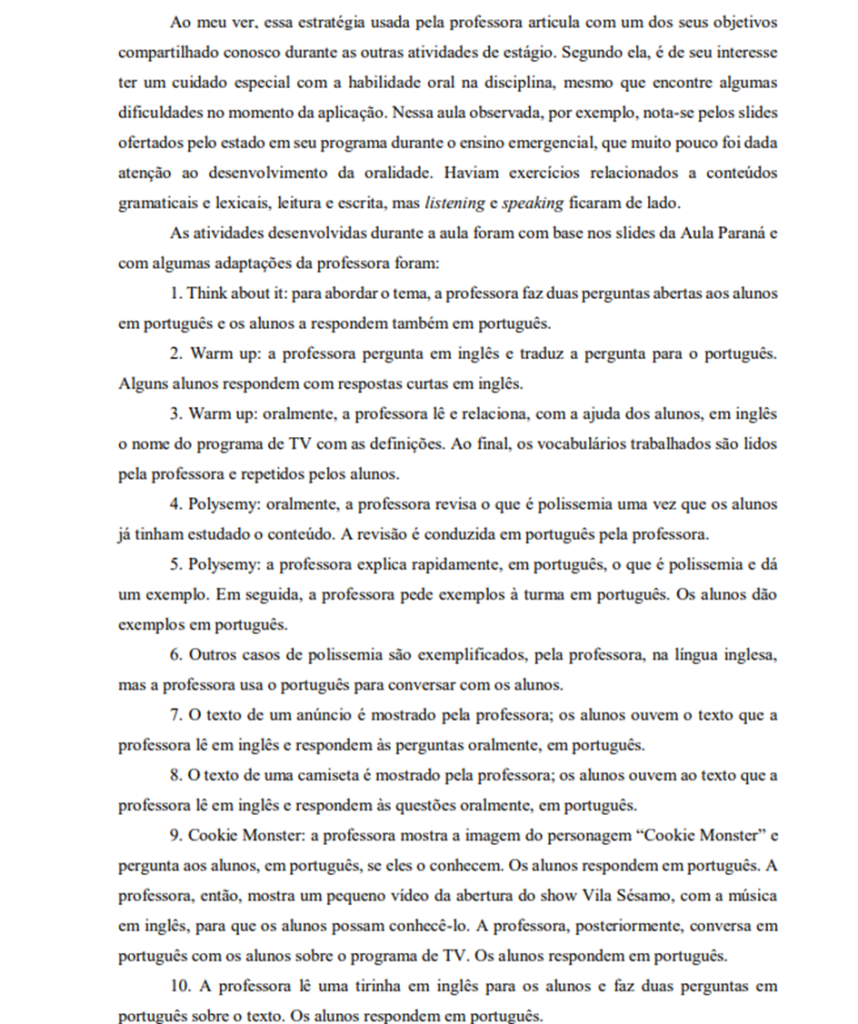
To answer our first research objective (to identify oral-practice activities in the teaching of English as a foreign language in remote classes in a public-school context), we present, in table 3, the activities developed in the online class observed, in which the main objective, as possible to conclude throughout the class, was the linguistic knowledge axis, lexicon and grammar studies.
Table 3 – Actions, actors and abilities explored in the class observed
| Activities developed by the teacher of the observed class when presenting the content of polysemy proposed by the slides in the ‘Aula Paraná’ platform | Abilities | Actor and actions | ||||
| W | R | L | S | Teacher | Student | |
| 1. Think about it: to approach the topic, the teacher asks two open questions to students in Portuguese and students answer in Portuguese. | X | Asks | Answers | |||
| 2. Warm up: the teacher asks in English and translates the question into Portuguese, which was on the slides of “Aula Paraná”. Some students answer with short oral answers in English. | X | Asks and translates | Answers | |||
| 3. Warm up: orally, the teacher reads and relates, with students’ help, in English the name of the TV program to the definitions. At the end, the worked vocabularies are read by the teacher and repeated by the students. | X | Reads and relates | Relates | |||
| 4. Polysemy: orally, the teacher reviews what polysemy is once students have already studied the content. The review is conducted in Portuguese by the teacher. | X | Reviews | Listens | |||
| 5. Polysemy: more interactively, the teacher quickly explains, in Portuguese, what polysemy is and gives an example. Then, the teacher asks the class in Portuguese for examples. Students give examples in Portuguese. | X | X | Explains and brings examples | Listens and gives examples | ||
| 6. Other cases of polysemy are exemplified, by the teacher, in the English language, but the teacher uses Portuguese to talk to students. | X | Brings examples | Listens | |||
| 7. The text of an advertisement is shown by the teacher; students listen to the text that the teacher reads in English and answer the questions on the content studied orally and in Portuguese. | X | X | X | Brings examples by presenting a text | Listens and answers | |
| 8. The text of a T-shirt is shown by the teacher; students listen to the text that the teacher reads in English and answer the questions orally, in Portuguese. | X | X | X | Brings examples by presenting a text | Listens and answers | |
| 9. Cookie Monster: the teacher shows the image of the character “Cookie Monster” and asks students, in Portuguese, if they know it. This was already proposed by the material used. Students answer in Portuguese. The teacher, then, to add to their class, shows a short video of the Sesame Street show’s opening, with the song in English, so students can get to know it. The teacher, later on, talks in Portuguese with the students about the TV program. Students answer in Portuguese. | X | X | Shows the image and asks. Shows the video and talks | Observes and answers. Observes/ Listens to the video and talks | ||
| 10. The teacher reads a comic strip in English for students and asks two questions in Portuguese about the text. Students answer in Portuguese. | X | Reads and asks. | Listens and answers. | |||
The focus of the class observed, as possible to conclude by the description of the activities, was the teaching of polysemy, which would be classified as belonging to the linguistic knowledge axis of BNCC, developing lexicon and grammar studies. Besides the fact that developing speaking skills was not the main focus of the class, it was observed that in most of the activities the teacher tried to expose students either to listening to or speaking the foreign language being studied. Writing, on the other hand, was not developed in the class observed. However, it is important to point out that only one class is considered in this case study; so, in previous or future classes, the focal point could be abilities that were not emphasized on the day of the observation.
Another fact to examine, is that the slides of “Aula Paraná” themselves aimed at students’ written and oral production at home once they were studying autonomously with the recorded class, both written and oral. Some examples of the activities suggested in the recorded class were: registering students’ answers in their notebooks; thinking about the answer; and answering the questions by themselves. All of these practices, which were the ones available at the time, generate a lack of participation and interaction once students were alone and they were supposed to solve the exercises individually. So, that could explain why some abilities were more emphasized and practiced than others.
The teacher of the observed class, when using the slides to review the content of the video lesson, adapted the exercises so that students could participate orally. In a previous conversation with the teacher in another stage of the internship, the teacher mentioned the fact that in their classes, they had been trying to enable students with the speaking practices by using the communicative approach. Defined by Rosamond Mitchell in chapter 3 of the book Teaching Modern Languages (SWARBRICK, Ann, 1994, p. 37), the communicative approach is a way of enabling students with situations similar to real-life experiences in which the language being studied would be used. It is also said by Mitchell that this approach most emphasizes the speaking and listening skills. The adaptations done by the teacher were clear when identifying and analyzing students’ oral participation in the class. As the focus of our study is the development of oral skills, we stick to the speaking activities more specifically.
Parupalli Srinivas Rao, lecturer in English, in his writing “The Importance of Speaking Skills in English Classrooms” (RAO, 2019), brings several benefits up when it comes to learners developing their speaking skills. As to exemplify, speaking a foreign language helps not only career-wise, but also directly in the learner’s confidence level. “In the present modern world, everything is linked with speaking skills” (RAO, 2019, p. 10). During our study case, oral-practice activities identified in the teaching of English as a foreign language in remote classes in a public-school context were mostly through the interaction of students with the teacher. The teacher, as stated before, tries to make use of communicative strategies to expose their students in order to develop their speaking skills in their classes, as much as possible.
As possible to conclude when analyzing activities 1, 2, 3, 5, 7, 8, 9, and 10 (see table 3, page 8), the teacher tries to have speaking skill to be developed even when confronting some certain limitations such as the remote context and the focus of that specific class. This exposition to speaking skill happens mainly as in a teacher-asks-and-students-answer situation. During activity 2, for instance, the teacher asks questions disposed on the slides “Aula Paraná” and students answer with short oral answers in English, showing advances when it comes to using the foreign language to communicate orally.
In what refers to our second research aim (to establish the (in)coherence between the oral practice observed and the ones recommended by BNCC), it is possible to observe on table 3 that most of these speaking activities proposed had a teacher-student interaction. Most of the time, the teacher provides a starter for the dialogue, as when the questions from “Aula Paraná” slides were asked. In some cases, the teacher asks and students answer, as in activities 1 and 2; in other moments, the teacher reads and, after it, asks the questions, so students practice more than one ability in the same exercise – activities 7, 8 and 10, for instance. There are also some exercises in each students exemplify the content, but only after the teacher asks once more.
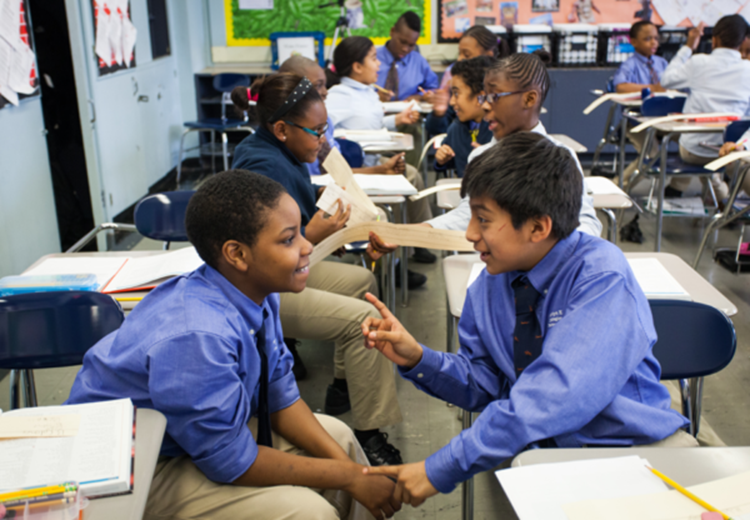
Image 3: Students engaging/interacting with the class

Source: https://www.lincolninst.edu/sites/default/files/styles/issue_feature/public/sources/articles/04.22_k12.ll_.png?itok=hBhg82mJ
Considering the thematic units and the objects of knowledge established for the 7th grade on the BNCC document in the oral axis (see table 1, page 6) we analyze the activities developed in the class observed and summarized on table 3. It seems, when comparing the activities developed in the class observed and the thematic units and objects of knowledge in the oral axis of BNCC, that the speaking activities do not meet all the recommendations of the document in the class observed. However, it is worthwhile noting that the focus of the class itself was not an oral genre, but the linguistic knowledge axis, with lexicon and grammar studies. The adaptations done by the teacher according to their approach, nevertheless, enable students to have a greater exposition to the listening and speaking practices. And once these adaptations also compound the class, they are our focus in this analysis.
Thoroughly examining the activities of the class, the ones that could be classified in the discursive interaction unit, practicing speaking in the English language, are:
· 1 (Think about it: to approach the topic, the teacher asks two open questions to students in Portuguese and students answer in Portuguese);
· 2 (Warm up: the teacher asks in English and translates the question into Portuguese, which was on the slides of “Aula Paraná”. Some students answer with short oral answers in English);
· 3 (Warm up: orally, the teacher reads and relates, with students’ help, in English the name of the TV program to the definitions. At the end, the worked vocabularies are read by the teacher and repeated by the students); and
· 5 (Polysemy: the teacher quickly explains, in Portuguese, what polysemy is and gives an example. Then, the teacher asks the class in Portuguese for examples. Students give examples in Portuguese).
Besides the fact that students were also producing and comprehending in the foreign language, the activities would not be classified as units of oral comprehension or oral production because of the focus of the class itself; there was no oral text being studied. Students’ participation in English was only when interacting with the teacher, collaborating with the teacher’s approach and their choice of how to explore and review the content studied.
We could conclude, then, that the activities proposed during the class observed briefly help developing the competences established by the BNCC document. To give an example, students communicate, even very little, in the English language and elaborate linguistic-discursive repertoires of the English language, respecting, of course, their limitations; and the teacher stimulates their students not only into oral comprehension practices, but also into producing using the English language. Furthermore, if we consider the other axis – which are not our focus, when it comes to reading, students are exposed to reading practices of short texts in English. When it comes to the linguistic knowledge axis, which was the main focus of the class itself, lexicon and grammar studies are conducted, practicing the linguistic analysis to reflect on the functioning of the English language.
Finally, in what refers to our third research aim (to understand how students participate in the oral-practice activities observed), as mentioned before in the methodology section, the 7th grade group was chosen due to their oral participation in class. In spite of this, not all students had the same behavior facing the activities proposed by the teacher. It is important to point out that even preparing activities that aimed at interaction during the class so students could feel more engaged, as the context of the class observed was still online, the teacher could not have all students participating, especially speaking-wise.
To understand students’ general participation, we use Fogaça’s (2010), Lenharo and Cristovão’s (2016). categorization of students’ responses to classify their engagement to the activities proposed by the teacher. These responses, or acts – as the authors call it, are categorized as: general responsive act, restricted responsive act, general spontaneous act, restricted spontaneous act, and spontaneous responsive (see table 2, page 7). It is important to mention that the scope of our analysis was not to classify student by student’s participation, but to consider their general participation in the activities as a group.
In most of the responses, students had either a general responsive act or a general spontaneous act, as possible to confirm by analyzing activities 1, 2, 5, 7, 8, 9, and 10. These two acts are called general due to the fact that students are answering something asked by someone else, they are not producing their speech spontaneously. The difference is that in the responsive one, the speakers interact with the whole group; and in the spontaneous act, it is only with the teacher and/or with a classmate.
According to Abdullah, Bakar, and Mahbob (2012), there are some factors that may interfere in students’ participation, such as personality and environmental factors, the influence of instructor in classroom and the influence of classmates or peers. The responses found, then, seems to happen because of the format of the class, which combines these two factors with the influence of both teacher and students. As students were online, they would have to open up their microphones before saying a word. So, it does not happen as spontaneously as in a face-to-face class.
Furthermore, in general, students answered the questions in different ways:
a) Oral answers in Portuguese;
b) Written answers in Portuguese through the chat;
c) Short oral answers in English;
d) Long and grammatically structured oral answers in English;
e) Long and grammatically structured answers in English through the chat.
With different responses and respecting students’ limitation, throughout the whole class it was possible to perceive students’ engagement in all the activities. Moreover, it may be a reflection of the teacher’s recognition of their group and students’ needs, as brought before in this research. It was told by the teacher that the choice of reviewing what was being studied in the ‘Aula Paraná’ platform was justified by the fact that as they were together before the online classes, the teacher really knew how it worked better for their students.
This research extends our knowledge of the oral-practice activities in the teaching of English as a foreign language in remote classes in a public-school context in relation to the prescriptions of the BNCC document and students’ participation since we brought not only what is prescribed, but also a real class observation in the case study. With that, teachers and future teachers may reflect upon students’ responses and engagement to the activities proposed and consider it when planning their classes according to BNCC, in meaning to create an environment in which students may develop their speaking skills in the foreign language studied. As it is a relatively recent document, teachers are still getting used and adapted to how to implement it in their classes.
Very glad I was when observing the class and having the possibility to notice that the 7th grade students of the class observed were having a moment of opportunity to develop their speaking skills during their class. It is known that, outside of their English class, students are not used to be exposed to the foreign language being studied in many other moments and situations. So, it was once possible due to the teacher’s adaptation and their will to expose students to speaking and listening as much as possible. As stated in the introduction section, there are many approaches to be used by teachers in meaning to develop, considerably, speaking. The communicative approach, the one used by the teacher of the class observed, is one that I myself relate the most.
There are, however, many more steps to be taken. We cannot overlook the fact that having those few moments of speaking may not completely prepare students for a moment of real-life conversation. There is still a lack of practice considering the oral exposition and practice. We should keep in mind that the high number of students per class is one of the obstacles when analyzing students’ oral production. How would the teacher listen to and/or evaluate each of the forty students in a hypothetical class?
Although the current study is based on a small sample of participants, the findings suggest that oral-skill activities were presented in the observed English class in the public-school context research with certain limitations; as to exemplify, the focus of the class itself was not, mainly, the development of oral skills. The oral practice only happened as a will of applying the communicative approach adopted by the teacher when leading the class observed. Also, the remote context also influences the results found once students would not speak as spontaneously as in a face-to-face context.
What was stated in the previous paragraph leads us to our second conclusion: the speaking activities developed during the class briefly help developing the competences established by the BNCC document. It is essential that we state, once more, that it may have happened as a consequence of the focus of the class observed being the linguistic axis.
When we consider students’ engagement to the speaking activities proposed, the remote context, as a consequence of the social distancing caused by the pandemic moment, also has a great influence in how they engaged. We found that students were less likely to answer questions spontaneously, both in English and in Portuguese; they would produce using the foreign language mostly when asked by the teacher – and it happens not only spoken, but also written.
Finally, a number of important limitations need to be considered. First, the pandemic itself was a huge influence when it comes to the results found once there were bigger concerns as health, hunger, access to the technology and many other things to be mentioned. This way, our observation was only possible to be done online, bringing many obstacles both to the teacher and to students. Secondly, we could only have one class observed and the focus of this class, as mentioned before, was not the development of the oral skill specifically. Thirdly, after the class, we could not have access to its recording. So, students’ participation was just registered during the class observation in the reflexive diary attached to this paper. It is unfortunate that the study did not include students’ individual participation and excerpts of their oral productions.
This study provided new data regarding the development of English oral skills in a public-school context by the observation of a real class; however, more thorough analysis is necessary in order to collect students’ individual participation. Also, it would be interesting to bring excerpts of their oral productions to add to the study.
REFERENCES
ABDULLAH, Mohd. Yusof; BAKAR, Noor Rahamah Abu; MAHBOB, Maizatul Haizan. Student’s participation in classroom: What motivates them to speak up? Procedia – Social and Behavioral Sciences 51 (2012) 516 – 522, 2012. Disponível em: https://www.sciencedirect.com/science/article/pii/S187704281203337X. Acesso em: 14 jul. 2022.
BRANCO, Emerson Pereira. A Implantação da BNCC no Contexto das Políticas Neoliberais. 136 f. Dissertação (Mestrado em Ensino) – Universidade Estadual do Paraná – Campus de Paranavaí. Orientadora: Shalimar Calegari Zanatta. Paranavaí, 2017. Disponível em: https://sucupira.capes.gov.br/sucupira/public/consultas/coleta/trabalhoConclusao/viewTrabalhoConclusao.jsf?popup=true&id_trabalho=5918643. Acesso em: 10 jun. 2022.
BRASIL. Base Nacional Comum Curricular. Ministério da Educação. Brasil, 2017. Disponível em: https:// http://basenacionalcomum.mec.gov.br/#:~:text=A%20Base%20Nacional%20Comum%20Curricular,e%20modalidades%20da%20Educa%C3%A7%C3%A3o%20B%C3%A1sica. Acesso em: 25 jul. 2021.
LENHARO, R. I. Participação social por meio da música e da aprendizagem de língua inglesa em um contexto de vulnerabilidade social. 2016. 150 f. Dissertação (Mestrado em Estudos da Linguagem) – Universidade Estadual de Londrina, Londrina, 2016. Disponível em: http://www.bibliotecadigital.uel.br/document/?code=vtls000207869. Acesso em: 30 jul. 2020.
RAO, Parupalli Srinivas. The Importance of Speaking Skills in English Classrooms. Alford Council of International English & Literature Journal (ACIELJ). Vol-2, Issue-2, 2019. Disponível em: https://www.researchgate.net/publication/334283040_THE_IMPORTANCE_OF_SPEAKING_SKILLS_IN_ENGLISH_CLASSROOMS. Acesso em: 05 jun. 2022.
SWARBRICK, Ann. Teaching Modern Languages. London; New York: Routledge, 1994. Disponível em: https://www.routledge.com/Teaching-Modern-Languages/Swarbrick/p/book/9780415102551. Acesso em: 05 jun. 2022.
Image 1 is available at https://teachlikeachampion.org/wp-content/uploads/TT-2-Image-600×416.png
Image 2 is available at https://englishclassviaskype.com/wp-content/uploads/2019/03/planning-English-classes-300×263.jpg
Image 3 is available at https://www.lincolninst.edu/sites/default/files/styles/issue_feature/public/sources/articles/04.22_k12.ll_.png?itok=hBhg82mJ
ATTACHMENTS
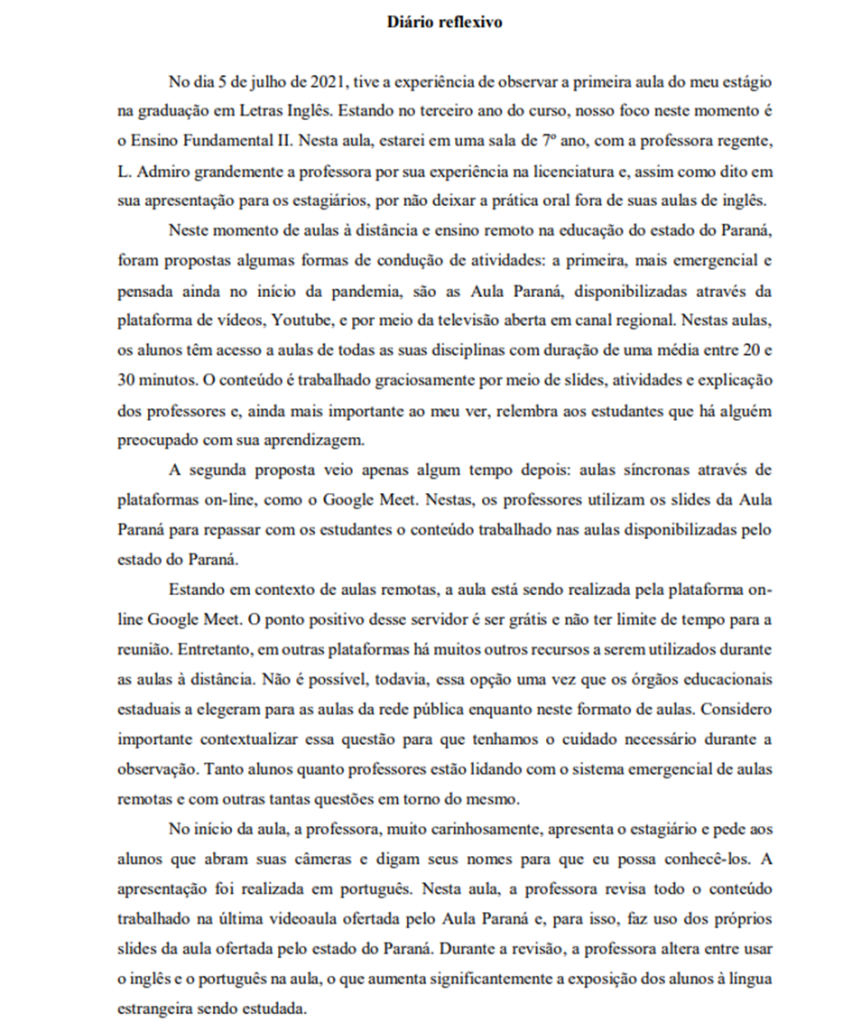
Attachment: Reflexive diary developed by the researcher’s author when observing the remote class of the case study
[1] From the original: Ao dizer que os conteúdos curriculares estão a serviço do desenvolvimento de competências, a LDB orienta a definição das aprendizagens essenciais, e não apenas dos conteúdos mínimos a ser ensinados.
[2] From the original: Verbal […], corporal, visual, sonora e digital […] para se expressar e partilhar informações, experiências, ideias e sentimentos em diferentes contextos.
[3] From the original: Situar a língua inglesa em seu status de língua franca implica compreender que determinadas crenças – como a de que há um “inglês melhor” para se ensinar […] precisam ser relativizadas.
[4] From the original: É a língua em uso, sempre híbrida, polifônica e multimodal.
[5] From the original: Práticas de compreensão e produção oral de língua inglesa, em diferentes contextos discursivos presenciais ou simulados, com repertório de falas diversas, incluída a fala do professor.
Author’s curriculum:

 Revista Contemporartes