
Author: Jose Vitor dos Santos Brandino (Letras Ingles Undergraduate at the State University of Parana, Apucarana, PR, Brazil)
Introduction
The objective of this paper is to raise the primary information of two works (MOREIRA, 2012) and (LIBERALI, 2020) regarding technology use in the classroom, and in a expository/argumentative way, it weaves possible comparisons, seeking to raise points in common and where they diverge in the use of technologies in education. Finally, it brings a personal reflection on the theme of how these studies impact my teacher development and worldview as a pre-service teacher, followed by a suggested dynamic (LEVISKY, 2008) that can help restructure the skills left aside during the pandemic. It is of utmost importance to keep in mind that the objects analyzed here have their contexts of production completely different, while the first, by Carla Moreira, was produced in 2012, Fernanda Coelho Liberali’s work took place during the pandemic period.
Digital Literacies in Education
Moreira (2012) opens a discussion regarding the use of technologies by teachers, through a case study with teachers from the Technological Education Center of Minas Gerais – Belo Horizonte (Cefet-MG) then proposes that literacy practices should be introduced in educational settings, and defines digital literacy so that we can better understand what it refers. Based on Borges and Silva (2006), the author explains that participation in the information society happens when one has the tools to interact and make use of new technologies. Among her motivations for the proposal, the author points out the resistance of some teachers in using technologies in the classroom, which occurs due to a lack of development, incentive and ”maturity”, in the positive sense of the word.

The concept of “literacy” for the author is the ability to access information and use it for one’s benefit; it goes beyond reading and writing only as skills, which would be the “literacy” performed by the school. Literacy is different because it refers to how citizens apply this knowledge in their daily lives to meet their needs. As for Digital Literacy, the ability to make use of technologies:
[…] consists of knowing how to use these resources to apply them in everyday life, for the benefit of the user. It is necessary, in this case, to investigate the reason for searching the web, that is, to know the purpose of this information for life to promote the acquisition of a (new) knowledge. (MOREIRA, 2012, p.3)
It is important to start from the premise that it is possible to have different levels of literacy, which can be influenced by many factors, such as the context in which students and teachers are inserted. After the author presents the results of her research, we conclude that several factors may prevent teachers from using technology in the classroom; we understand that the use of technology should not be done by itself. It must have a purpose and be effective; the lack of infrastructure, training, opportunities, and the very collaboration of the educational system may influence this process of insertion of technology in the classroom.
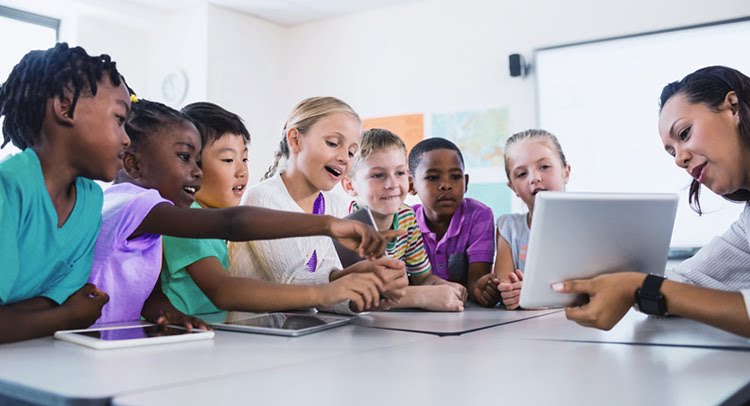
Source: https://direcionalescolas.com.br/o-papel-do-professor-frente-as-novas-tecnologias/amp/
Post-Pandemic Changes
Fernanda Coelho Liberali, professor and researcher at the Pontifícia Universidade Católica de São Paulo, through the text Construir o inédito viável em meio a crise do corona vírus – Lições que aprendemos vivemos e propomos, brings a series of reflections on the role of education in the pandemic context weaves a criticism of the necropolitics that occurred in Brazil in the same period raises concepts such as experiential heritage and answers, how can we do more for education in periods of uncertainty and collective despair. The author begins her work by explaining, based on Mbembe (2016), the concept of necropolitics, which is:
[…] the power of governments to decide who will live and who will die and how they will do them. Starting from a reading of politics as the work of death, the author explains that sovereignty expresses the right to kill.(LIBERALI, 2020, p. 13)
Liberalli explains that in the Brazilian context, this happened, and could be observed in some speeches of the current president of the country regarding the thousands of deaths caused by COVID-19, moreover, the author shows research that proves that despite the majority of cases of the disease being among citizens of the more favored classes, it was among the poorest people that the largest number of deaths were identified. Still on necropolis:
The idea that certain humans can be discarded unmasks the social,economic, cultural, and political inequality that plagues our reality and that is laid bare with the arrival of covid-19. The sameprocess seems to expand to education…in this scope, we can also perceive the necropower that generates necroeducation. While someprivate network students have access to all kinds of activities, through multiple platforms and remote applications, with teachersworking to exhaustion to contribute to a very high standard of qualityand expectations in a short period of time, students from publicnetworks, remote locations or even poorer contexts have been left tolive the death-in-life […] (LIBERALLI, 2020, p. 14)

Source: https://www.nytimes.com/2021/07/28/us/covid-schools-at-home-learning-study.amp.html
Once the challenges faced during the pandemic were new to everyone, students and teachers alike, it is common that feelings of despair and doubts about how to proceed are present in the collective to overcome this, the author raises Paulo Freire’s proposal about changing the focus and making the “unpublished viable”. Thus, the teacher promotes the student`s learning process so that it continues to happen within the possibilities that the context provides. This cannot
be accomplished:
Without the naivety of thinking that we have the unlimited power to deal with all the chaos, we live in but with the creative energy to think of ways and arrangements that take us beyond what has already been tried. And this possibility of restructuring our existence when faced with limiting situations is our mark of humanity, our strength to keep us in existence […] (LIBERALI, 2020, p.14)
The author says that she notices the effort of educators from all over the world to accomplish the unprecedented feasible, and exposes extremely sensitive data that could be identified bysome teachers who made contact with their students to know their real needs during social isolation. He also points out that the solution to necropolitics is liberating education, which first saves lives and then builds the teaching-learning process. Liberali, delves into the concept of ”experiential heritage” that:
[…] can be understood as the set of resources accumulated from dramatic events experienced with the other. These resources materialize (or not) in the means by which subjects interact with the world and comprise linguistic, cultural, emotional, and social aspects. (LIBERALI, 2020, p.15)
It is important, in these challenging moments, that the most varied experiential patrimonies are considered while searching for solutions to such challenges. The problems caused by the pandemic go beyond the health crisis itself since they reinforce the social problems present today. Finally, Liberali, makes reflections on the question “how can we move forward?” Regarding all the impact suffered during the peak of the pandemic, the answer lies in taking our “being teachers” to a place of social transformation, to think and use tools that goagainst necro politics and necro education. And we understand they are present in the pedagogy proposed in several works by Paulo Freire.
Final remarks
All in all, by reading both texts we can understand that the context of the use of technologies in the classroom goes beyond what is possible for teachers to control . It is necessary to take into account the reality of each student. The same experience is perceived in totally different ways, considering the background of those involved. We could also notice this in the several cases that we had contact with through the media in 2020 and 2021, of students in vulnerable situations with several problems, from the lack of monitoring of school tasks to the lack of technological resources to perform basic activities. After comparing the objects, we noticed that the teachers’ perceptions regarding the use of technologies in the teaching-learning process have changed from a compulsory perspective with the passing of the years and the arrival of the pandemic. If before, the use was optional, needed to be encouraged, and could be thought about with time and caution, now it has become mandatory and a major objective of those who could not think about this reality before, due to several issues, whether economic, social, or political.
References
LEVISKY, F. B. Psychoanalysis Contributions to Education: the group as the subject of creation. 156 p. Dissertation (master’s degree) – Graduate Program in Psychology, Institute of Psychology, University of São Paulo. São Paulo, 2008.
LIBERALI, F. Educação em Tempos de Pandemia: Brincando com um mundo possível. 1.ed. SÃO PAULO: Editora Pontes, 2020. 13 p.
MOREIRA, C. DIGITAL LITERACY: FROM CONCEPT TO PRACTICE. 2012. 15 f. SIELP Annals. Volume 2, Number 1. Uberlândia: EDUFU, 2012.
Images
Available at https://agorarn.com.br/ultimas/alunos-da-rede-publica-ficam-meses-sem-atividades-remotas-na-pandemia-2/. Access on Nov. 26th, 2022.
Available at https://direcionalescolas.com.br/o-papel-do-professor-frente-as-novas-tecnologias/amp/. Access on Nov. 26th, 2022.
Available at https://www.nytimes.com/2021/07/28/us/covid-schools-at-home-learning-study.amp.html. Access on Nov. 26th, 2022.
 Revista Contemporartes