
The United States are around the corner of a celebrating date – October 31st – the eminently North American cultural phenomenon, Halloween. In Brazil, at this time of the year, private language schools are decorated with witches, pumpkins, and bats for the celebration of Halloween. Brazilian students come to class wearing costumes and monster masks.
Halloween is a fundamentally mystical celebration, referring to a pagan Celtic tradition of almost 2,000 years ago. This tradition was based on the belief that in the passage from the night of October to the first of November, which marked the New Year, the spirits of the dead came to join those of the living. Later, the Catholic Church traditionally adopted this day as ‘All Saints’ Day’.

Also, this time of the year in Brazil is Saci’s folkloric day. Saci-Pererê is a Brazilian cunning and mischievous black boy legend that has been portrayed in children’s literature by remarkable Brazilian literary writer Monteiro Lobato.
According to Fernandes (2020) this day was established in 2003 by congressman Aldo Rebelo’s Federal Law Proposal (LP) 2.762 in order to rescue and value the folklore of the country, promoting national culture and Brazilian traditions.
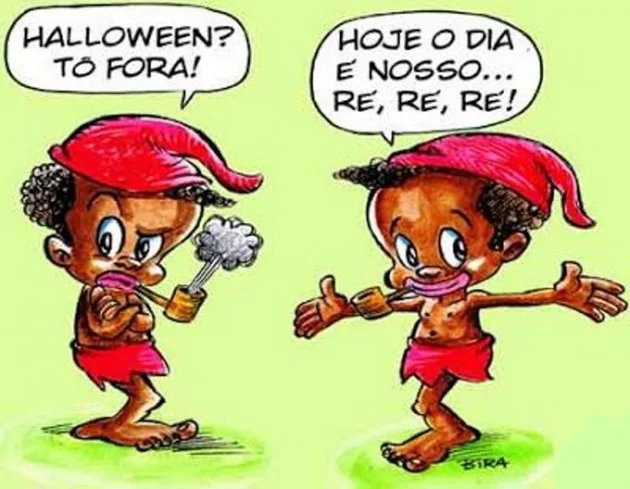
Federal LP 2.762 excerpt: Instituting the “Saci’s Day” represents offering society an instrument for valuing popular culture as a fundamental element in the constitution of Brazilian identity. Through the annual forecast of commemoration of the date, in the form of cultural events and festive activities, the initiatives propose the rescue and appreciation of our traditions and original folkloric manifestations.
When we reflect more on the subject, we will understand that language and culture are intrinsically related, since language expresses, embodies, and symbolizes a culture. The status of English as the hegemonic language is evident by its presence in most cultural media productions, such as films, television and radio programs, music, advertisements, newspapers, magazines, computers, internet, which drive commerce and the clothing industry, fashion, and eating habits. Cultural exclusivism, arising from the political, economic, and technological power of the United States, is present in a globalized society and is incorporated in a ‘natural’ way in other cultures, or, as the Brazilian educator Paulo Freire would say, there is a ‘hosted invader inside of us’.
Therefore, we see an uncritical position toward the Halloween phenomenon in our Brazilian schools. There is an alienating cultural apparatus, as Moita Lopes (1996) states, that leaves rare gaps for the colonized to breathe. We are culturally colonized, and we colonize our students in schools’ classrooms, and children in shopping malls, when we do not stick to a perspective of cultural relativism that takes into account the history and true meanings of cultural events like this, in the same way as we should take into account folkloric traditions in Brazil.

School is a social place where urgent issues that question human life, the reality that is being built, and that require macro-social transformations, and also, personal attitudes need to be introduced to students. Therefore, both cultural themes Halloween and Saci’s Day can be studied through school contents that lead the pupils to debate, to a cultural relativism and to critical thinking, in curriculum disciplines, such as languages, geography, history, philosophy, and art.
Finally, we ought to culturally educate ourselves (parents and teachers) and our children and students about the foreign culture/language and, mainly, our culture/language.
References:
ALMEIDA, R. S. HALLOWEEN: A CONTEMPORARY CROSS-CUTTING THEME IN SCHOOLS. English Newsletter. Culture and Education, Universidade Estadual do Paraná, Campus Apucarana. Available at: https://unesparenglishnews.wixsite.com/newsletter/c%C3%B3pia-a-very-domestic-cat-july-17t-1. Access on: Sept 25th, 2022.
ALMEIDA, R.S. A alienação cultural do Halloween. Jornal Tribuna do Norte do Paraná. Opinião. 30 de outubro de 2015.
BRASIL. PROJETO DE LEI N.º 2.479-A, DE 2003. Câmara dos Deputados. Available at: https://www.camara.leg.br/proposicoesWeb/prop_mostrarintegra;jsessionid=3F1681CE2E36828DEDFDA88D09D6A591.node2?codteor=301007&filename=Avulso+-PL+2479/2003#:~:text=Institui%20o%20%E2%80%9DDia%20do%20Saci,de%20valorizar%20a%20cultura%20nacional.&text=folclore%2C%20a%20cultura%20e%20as%20tradi%C3%A7%C3%B5es%20brasileiras.&text=em%20seu%20calend%C3%A1rio-,de%20eventos%2C%20atividades%20que%20promovam%20a%20divulga%C3%A7%C3%A3o,data%20em%20todo%20o%20Pa%C3%ADs. Access on: Sept 25th, 2022
FERNANDES, M. O dia do Saci. Available at: https://www.todamateria.com.br/dia-do-saci/. Access on: Sept 25th, 2022.
MOITA LOPES, L. P. da. Oficina de lingüística aplicada: a natureza social e educacional do processo de ensino/aprendizagem de línguas. Campinas, SP: Mercado das Letras, 1996.
Images:
Available at: https://auditeste.com.br/halloween-origem-e-tradicao/
Available at: https://www.todamateria.com.br/dia-do-saci/
Available at: https://www.todamateria.com.br/dia-do-saci/
 Revista Contemporartes