
Speaking languages (either the vernacular or foreign/additional languages) serves to build knowledge and create spaces for understanding between different cultures through dialogue-affirmation-confirmation of one’s own cultural identity in recognition and respect for other cultures and their particularities.
In this sense, the possibilities that languages offer for other readings are highlighted by Bourdieu (1991). He posits that knowledge of a foreign language means having access to other ways of interpreting and undestanding the world. Finally, we can reach other perspectives of reading about ourselves, about people and about the cultures to which we belong.

In terms of traditional approaches and methods for teaching and learning a foreign language, the space for other readings is little explored, since the centrality of teaching is in the development of the student’s linguistic and communicative competences. The emphasis on the so-called ‘language skills’ supposes the application of cognitive faculties, focused on the acts of listening, speaking, reading and written expressions to the integration of these ‘skills’.
For a long time, foreign language teaching has prioritized a predominantly linguistic education, by focusing on the use of communicative/discursive practices and emphasizing them. This pragmatic approach occurs through the use of teaching methodologies and techniques that include systemic knowledge (grammar) and a set of communicative functions based on predetermined situations, serving as rules for the social use of the target language .
There is constant use of teaching and learning techniques recommended by manuals (textbooks), as if students were ‘educated’ in certain manners, and specific learning methods, without theoretical and critical grounds. According to Moita Lopes (1996), there has been a dogmatic view of language teaching and learning, basically involving the use of “ready and finished” techniques.
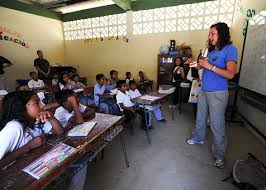
Also, Moita Lopes argues that the teacher’s performance in the use of foreign language teaching methodologies in the classroom becomes quite pragmactic, and a dogmatic process: “The classroom is the ‘place of certainties’ about what to teach, how to teach and why to teach”. Concerning what he calls “dogmatic education”, he advocates that the theory of language developed in a contemporary perspective of social use of language needs to be represented by the teacher in the classroom so that the student learns to do the same way in his/her future.

Furthermore, these teaching methods, according to Moita Lopes (1996, p. 180), are often developed by linguists and researchers (mostly foreigners) who are unaware of the contexts in which the foreign language is being taught: learning particularities, language needs for the student’s life reality, cultural aspects and social and economic contexts.
Thus, even though questions and inculcations by certain teachers arise regarding the limitations that underpin these methodological practices and the reduction of content by the textbooks and didactic materials, there are teachers who do not give up these foreign methodologies, nor the teaching materials, as they are considered efficient within what is expected of a quality education for the job market.
From this perspective, the social and dialogic nature of language is lost in the midst of concerns about equipping the student with strategies for the development of linguistic skills and communicative competence. In addition, Moita Lopes (1996) reminds that the teacher should propose to the student his/her engagement in discursive practices through dialogue and the pointing out of opinions. This is how the student will be able to participate in the social construction of meanings and in the reception and expression of messages and content about the different points of view and ideologies brought, for example, in the textbooks used in the classroom.
References:
BOURDIEU, Pierre. “Editor’s introduction”. Language and Symbolic Power. Cambridge: Polity Press, 1991.
MOITA LOPES, L. P. da. Oficina de lingüística aplicada: a natureza social e educacional do processo de ensino/aprendizagem de línguas. Campinas, SP: Mercado das Letras, 1996.
Images:
Available at: https://unsplash.com/s/photos/foreign-language
Available at: https://www.friendshipcircle.org/blog/2012/11/20/10-items-every-special-educator-should-have-in-their-classroom/
Available at: https://pixabay.com/images/search/teacher/
 Revista Contemporartes